As citizens increasingly turn to the internet to voice their opinions, share feedback, and seek information, it’s important that we show up in those key moments. Understanding and implementing Search Engine Optimization (SEO) strategies will enhance the visibility and reach of your online engagement initiatives so you can connect with your community at the right time.
You see, your community expects to reach you online. Whether it’s for information or interaction, when they conduct a quick search, they’re expecting the right result to appear. But, simply creating an online presence is not enough to reach the right audience.
With an effective SEO strategy in place, you can amplify the visibility of your community engagement initiatives and consistently increase the reach of your efforts.
Thankfully, SEO is not nearly as scary as it seems. And the steps to set yourself up for success are simpler than you might think.
What is SEO, and why is it important?
Before delving into the tips, it is crucial to grasp the significance of SEO in the context of community engagement. Simply put, SEO is the process of growing the visibility of a website or a web page on search engine results pages (SERPs). This means that your relevant audience can easily find and engage with your content.
For example, if you were conducting a corridor study of the I-5 through Downtown Seattle and you were inviting the public to contribute initial feedback then it would be useful if your project appeared for the following search results:
Downtown Seattle corridor study
Provide feedback for I-5 corridor study
Downtown Seattle I-5 corridor improvements
If you aren’tshowing up, then search engines aren’t classifying your content as useful or relevant enough. So, to combat this, we can make a few easy adjustments to improve the chances of appearing in the top search results.
And just to be clear, when we are talking about search results, we mostly mean Google Search. Currently, Google still handles more than 90% of all internet search queries.
Quick tips for enhancing SEO for community engagement.
Whilst there are a whole host of technical factors that go into SEO, the most important thing you can do is make sure the content you publish is reliable, authoritative, up-to-date, and easy to find.
To help your content meet these standards, here are 5 simple tips you can implement today:
Understand the power of keywords
Craft SEO-friendly headlines
Create high-quality, valuable content
Optimize metadata and URLs
Leverage internal linking
1. Understand the power of keywords.
Keywords are the foundation of successful SEO. For most content pieces, conducting thorough research to identify relevant keywords and phrases that will resonate with your audience is essential. In saying that, keyword research for community engagement is pretty straightforward!
Most of the time, your keywords will have a direct correlation with the project of focus. So, if we take our I-5 Corridor Study project as an example, you’d want to ensure ‘Downtown Seattle I-5 Corridor Improvements’ is incorporated throughout your content.
Ensure that your keyword is placed in your title tag, headline, paragraph headers, and body text. But, be cautious, your keyword needs to sound natural and shouldn’t be forced into text where it doesn’t fit – this is called ‘keyword stuffing’.
Headlines play a vital role in capturing the attention of your audience and search engines alike. Ensure your headlines are both catchy and optimized for SEO by using the appropriate header tags.
Header tags are an HTML element used to designate headings, usually from H1 to H6. You should use your related keywords in your headings and organize them appropriately. And, as a rule of thumb, each page should only have one unique H1 that described the main topic; this is often created automatically from your page title.
From here, you should ensure that your content is organized with sub-headings. This will not only make your content more scannable but also boost its visibility in search results.
If the title of our page is Downtown Seattle I-5 Corridor Improvements, we could include the following sub-headings to organize content:
H2: Shaping Downtown Seattle’s I-5
H3: Feedback So Far
H3: How to Provide Feedback on I-5 Corridor Improvements
H2: Opportunities to Have Your Say on I-5 Corridor
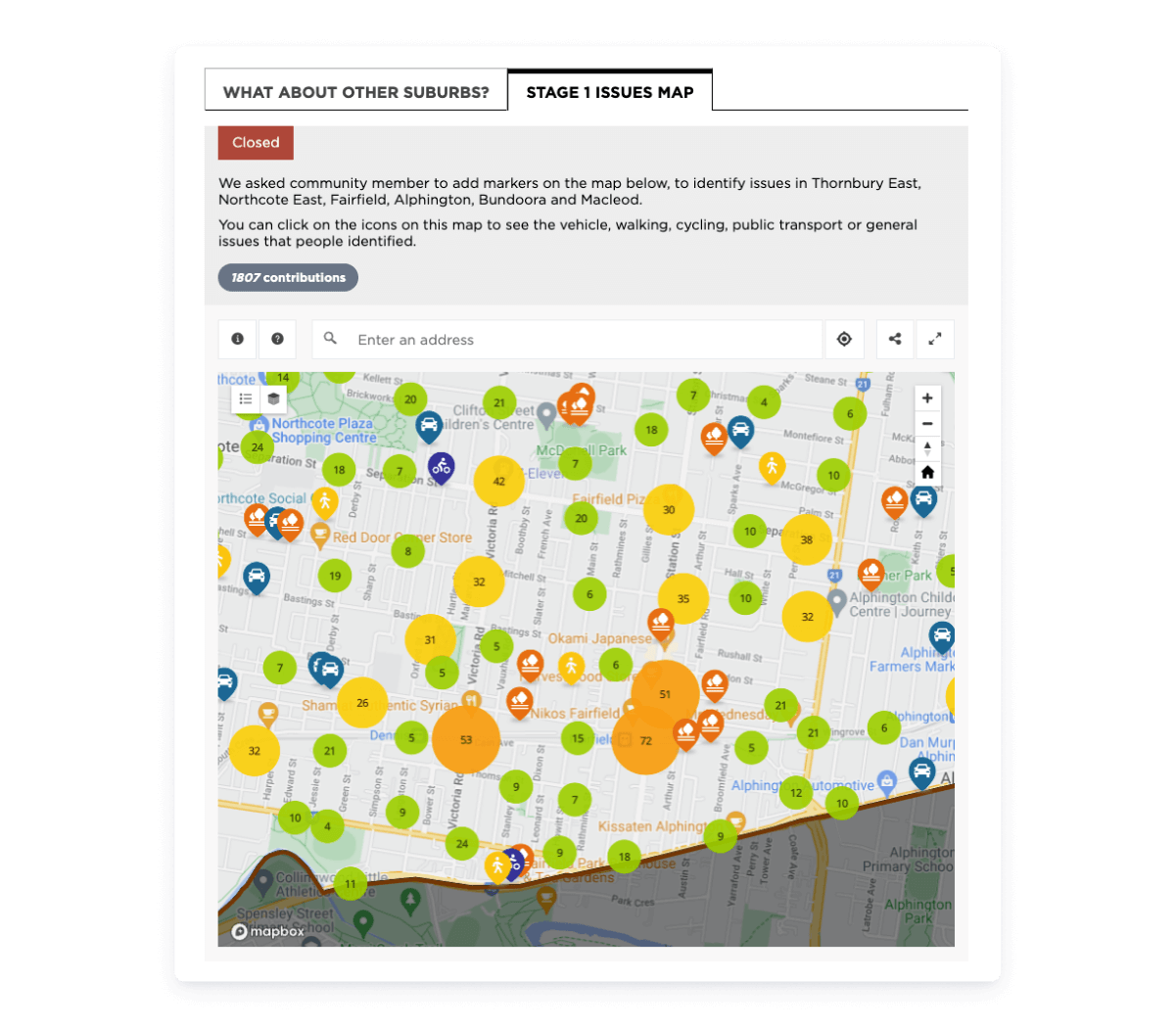
Utilizing participation tools, such as the Social Map, invites interaction and engagement which can greatly boost your visibility in search results.
3. Create high-quality, valuable content.
We hope this one isn’t too obvious, but engaging content is the heart of successful SEO. If you’re providing valuable and engaging information and solutions to the queries and concerns of your community then you’re off to a great start! Google favors fresh, well-research content, so ensuring your pages are kept up-to-date and relevant will improve your search rankings.
So, in the context of community engagement and our I-5 Corridor Improvements project, you could:
Include a project timeline with key milestones and phases that you can update as the project progresses.
Utilize a Social Map to gather location-based feedback within the study area and allow participants to pinpoint key opportunities or challenges.
Attach relevant documents, images, or videos to enhance your content and provide additional avenues of media consumption and learning.
Create an FAQ section to help address key questions or concerns that have arisen from the project so far.
Metadata? Optimizing URLs? We swear this isn’t rocket science. And, thankfully, within Social Pinpoint, our SEO section in Page Settings allows you to make all of these adjustments very fast.
Let’s start with metadata.
This information is what users will first encounter when they land on the SERP. So, crafting compelling meta titles and descriptions will leave a great first impression to draw in searchers and increase traffic.
Your meta title should summarize your page, include your target keyword, and stick to a 50–60 character limit. Your meta description should expand on and complement your title, we also suggest keeping the length of your description to 120–158 characters.
Here’s a compelling and descriptive example for our I-5 Corridor Improvements:
Meta title: Downtown Seattle I-5 Corridor Study – Provide Feedback
Meta description: The City of Seattle invites the public to provide input and consideration on where improvements are most needed.
Now, how about optimizing URLs?
Well, most page titles actually make perfectly optimized URLs, as long as they are simplified, and don’t contain any special characters or spaces.
Therefore, the URL for our example would be: downtown-seattle-interstate-5-corridor-improvements.
Directing users to specific sub-pages to submit feedback can help create more structure and hierarchy in your page, allowing you to leverage the power of internal linking.
5. Leverage internal linking.
Internal linking not only helps users navigate through your community engagement site but also assists search engine crawlers in discovering and indexing your content effectively. Internal links are really useful for establishing site architecture and showcasing related content.
Within the community engagement space, we see a lot of our clients host their participation tools within additional sub-pages. This not only helps add additional structure to their project content, but helps direct the community to the exact area/s to submit feedback.
And, if a project is near completion, or there have been a lot of updates, internal linking ensures your community has easy access to the most up-to-date and relevant information about how their feedback has shaped the end result.
A quick mention of technical SEO (the slightly scarier SEO).
So far, the tips and strategies mentioned are all elements of SEO you should have control over. However, there is another element to SEO that could be impacting your overall SEO success – technical SEO.
Technical SEO is the slightly scarier, more complex side of SEO. This is all to do with optimizing your website so it’s not only easy to crawl and index by Google’s standards, but that it also provides a positive (and fast) user experience.
Utilizing an online community engagement platform that meets these standards and provides a seamless user experience across all devices will positively contribute to technical SEO. Not to be biased, but Social Pinpoint’s responsive and accessible design meets these standards and invites interaction from your community.
Key takeaways
SEO is the process of growing the visibility of a website or a web page on search engine results pages – and it’s much more simple than you may think!
Make sure the content you publish is reliable, authoritative, up-to-date, and easy to find. For a lot of projects, especially ones that invite interaction and engagement from your audience, they may be already boosting the visibility of your page for you.
Small shifts in how your write, and adjusting settings on some of your pages could make a huge difference in the long run.
When it comes to collecting authentic and high-quality data, mandatory registration for your community engagement site can prove to be a valuable tool. With the implementation of mandatory registration, organizations can enhance their decision-making and community engagement efforts by ensuring that feedback is received from genuine individuals who are true residents of the area.
The mandatory registration process requires individuals to provide their personal details before participating in community activities. The data collected then enables organizations to consistently improve and tailor their engagement initiatives, therefore creating more relevant experiences that better cater to the specific needs of the community.
While mandatory registration may encounter certain barriers, such as community resistance and concerns about data collection, it is essential to prioritize transparency and openness throughout this process. By building trust within the community, and remaining honest about how data is collected and stored.
In this article, we will explore the benefits of using mandatory registration and provide recommendations on how to effectively implement this useful tactic on your community engagement site.
What are the benefits of mandatory registration for community engagement?
While open, public projects are great for community engagement and getting everyone involved, they can also come with their own challenges.
As these projects are available for anyone and everyone to get involved and have their say, it’s almost impossible to track unique instances of feedback or understand the demographic breakdown of responses. Data can be distorted and skewed, especially if certain stakeholder groups are actively dominating the conversation.
Because of this, these open projects sometimes have the ability to sway certain outcomes in a different direction compared to ideal participants and their preferences.
Even though you are receiving a large amount of feedback, these individuals may not actually be representative of your community of interest. This is where mandatory registration comes in.
By encouraging people to register on your community engagement site, you can remain confident that the feedback you are receiving is not only genuine but is coming from stakeholders that have a vested interest in the project.
With mandatory registration, you also gain access to more accurate and valuable insights, such as demographic data, to better understand your community’s needs and concerns. This valuable data empowers you to tailor your engagement strategies to ensure you are truly reaching a representative cross-section of your community and effectively target the right audience.
Mandatory registration allows organizations to maintain a database of community members, enabling you to establish stronger connections, gather feedback, and provide personalized support. It can also be used to facilitate effective communication, as registered participants can be notified about upcoming events, updates, or opportunities for involvement.
And, as you consistently capture unique data from community members, you can further understand and identify where you may see gaps in representation and reach – allowing you to pivot your strategy when needed.
How can you implement mandatory registration for community engagement?
If you are considering implementing the use of mandatory registration for your community engagement initiatives, let’s explore the recommended steps to help you get started.
1. Gradually implement mandatory registration.
Whilst change can be new and exciting, your community may be confused or concerned about the shift.
If you were to suddenly implement mandatory registration, you may encounter resistance from your community. Folks may have questions about the purpose of data collection or the need for providing personal information. People can be very cautious about their personal data and privacy, especially among older generations.
If you’re looking to implement mandatory registration, we’ve had a few clients trial this technique on specific projects or different participation tools – just so they can understand the impact this may have on feedback.
It is also important to be open and transparent with the public about your intentions, by providing information and addressing any concerns or questions you can ensure everyone is on the same page.
2. Inform your community through various communication channels
Okay, so you’ve conducted a trial with your community, and you’re ready to implement mandatory registration across your entire engagement site. What’s next?
To prepare your community and ensure they are well-informed about this change, early communication is key. But what is the most effective approach?
We recommend using a mix of information and visuals to explain the change. Visuals can be highly effective in conveying information as they are often easier to understand compared to plain text. Videos, in particular, provide a powerful tool to explain the process and highlight the benefits.
It is also vital to select the appropriate platforms to reach your community effectively. Review where your community connects with you most and consider utilizing multiple channels to maximize your reach and engagement.
Let’s delve deeper and review which channels you can utilize to inform your community regarding mandatory registration.
Email marketing campaigns.
By evaluating your existing membership base, you can work towards developing an email marketing campaign to inform your community of this change. The primary objective of this campaign will be to ensure that your clients are well-informed about the change, including its purpose, benefits, and any necessary actions they need to take prior to the implementation date.
This personalized approach will help foster engagement, maintain transparency, and enhance the overall user experience throughout this transitional phase.
Social media promotions.
It is likely that some individuals may have previously opted out of receiving emails, while others may not have received them simply because they haven’t subscribed to your email campaigns. Therefore, it’s crucial to ensure that these individuals are still informed about the change. One effective alternative for reaching out to your community is through your social media channels.
Social media serves as an excellent platform to keep people updated and also offers an opportunity to expand your membership base. This can be accomplished either through organic reach or through paid advertising campaigns.
Website articles and FAQs.
Your organization’s website (or current engagement site) serves as a centralized hub of information, allowing anyone who visits the site to easily stay informed about changes and recent developments. By featuring this important update on the homepage, you ensure maximum visibility and accessibility for a wide range of users.
This also presents an opportunity to direct users to an article, video, or frequently asked questions (FAQ) section, offering more detailed information to address any potential confusion.
3. Implementing and evaluating your mandatory registration process.
Once you have informed your community, it is now time to implement mandatory registration (you made it!).
Throughout this implementation period, you may get some more confusion or pushback, but it’s important to be patient with your community and provide more support to ensure folks feel safe and informed.
At the end of the day, this will save your community loads of time as they won’t have to consistently enter demographic information. And, people will only receive the most relevant updates and notifications that align with their interests.
Once implemented, it’s also important you carefully monitor and evaluate whether mandatory registration aligns well with your community. Have you achieved your intended objectives? This includes gathering feedback from a wide variety of tools and analyzing the quality of feedback you’ve collected.
By assessing the quality of feedback and overall satisfaction of participants, you can easily pinpoint any challenges or barriers faced by your community and identify areas for improvement.
Is your feedback more representative of your intended audience? Are you identifying greater gaps in your engagement strategy and targeting? Do you need to focus more on specific age groups? Are locals in certain areas not engaging?
Implementing mandatory registration gradually enables the collection of higher-quality feedback and promotes authentic engagement within the community. By addressing concerns and maintaining transparency regarding data collection and usage, you can effectively mitigate fear and resistance among community members.
Additionally, leveraging a variety of communication channels such as email marketing campaigns, social media platforms, and your organization’s website ensures widespread visibility and accessibility. This approach guarantees that all community members stay well-informed about updates and changes, fostering a sense of unity and shared understanding.
Private community engagement projects empower organizations to foster meaningful connections, facilitate focused discussions, and build stronger relationships with specific groups within their community. They can be highly effective for targeting key stakeholders, and driving focused discussions.
Sometimes, you may not want every single community member to provide input. We know this might sound a little crazy, but bear with us. You see, when it comes to community engagement, organizations may adopt various approaches when interacting with their community.
More often than not, projects are made public, aiming to engage with a wide range of community members. Public projects invite interaction and engagement from everyone and allow you to reach all of your intended audience.
Recently, we have seen the rise of private projects, focusing on specific groups for more targeted discussions. Private projects allow you to segment your community and provide a more personalized, focused approach for your engagement.
Let’s explore the advantages of using private projects to foster meaningful collaboration and participation in community engagement initiatives.
What is the Difference Between Public and Private Projects for Community Engagement?
Before diving into the advantages of private projects in community engagement, let’s first gain an understanding of the concept of private projects and how they differentiate themselves from public projects.
Public projects for community engagement
In community engagement, public projects aim to involve a broad spectrum of participants, welcoming individuals from diverse communities. These projects seek diverse perspectives and strive to include as many individuals as possible.
Public projects prioritize openness and transparency, empowering participants to contribute to decision-making processes. Organizations may utilize broad strategies, such as hosting public meetings, utilizing online platforms, and conducting surveys, to engage with a broad spectrum of individuals and collect their feedback.
By embracing public participation, you provide each individual with the chance to express their views and actively engage in the decision-making process.
Private projects for community engagement
On the other hand, private projects for community engagement are more exclusive and limited to specific groups. They’re all about bringing together a select bunch of individuals or stakeholders who have a direct interest or expertise in the project.
Private projects enable concentrated discussions and collaborations within a smaller, carefully selected group. Generally, this allows for in-depth exploration of specific topics or addressing particular issues more relevant to the audience present.
They provide greater control over participant selection and enable the maintenance of confidentiality when necessary. Private projects also offer a dedicated space for the appropriate individuals to collaborate and focus on finding solutions without any disturbances.
An example could be a new Placemaking Strategy for a local restaurant hub – involving key stakeholders, such as restaurant owners, tenants, workers, and nearby residents, in an initial consultation could help build greater trust and transparency.
Benefits of Using Private Community Engagement Projects
Engaging with the community through private projects can offer many benefits to help you enhance the effectiveness and outcomes of your engagement process. Here are some key advantages to consider.
Maintain confidentiality and security
In community projects, effectively handling sensitive information, proprietary technology, and confidential partnerships is crucial. Consequently, ensuring privacy, preventing data breaches, and avoiding disclosure to competitors or the general public are essential factors to be mindful of.
Private projects offer a secure and controlled setting for sharing sensitive information, typically implemented through a login system. By utilizing login credentials such as usernames, passwords, or additional authentication methods, private projects can ensure that only authorized participants can access the project’s content and resources.
For instance, let’s consider a community project aimed at collaborating with a local school to develop innovative teaching methods. To maintain strict confidentiality, a private project can be created, granting access solely to relevant school staff and company representatives who need to access sensitive data. This approach safeguards the interests of both the school and the collaborating company.
By implementing a private project in this context, secure information sharing is facilitated. Therefore, you are able to foster trust and confidentiality among the involved parties by ensuring that sensitive information is handled with the necessary precautions.
A community engagement platform that has achieved the highest standard of security, safety, and support, such as ISO 27001 Accreditation would allow you to remain confident in data privacy and integrity.
Focused collaboration with key stakeholders
Private community engagement projects enable collaboration with specific groups or members who are directly involved in or have a particular interest in the project. By limiting the project’s access to the designated group, participants can delve deeper into the topic, sharing their experiences, expertise, and ideas more openly without external distractions or noise.
For example, let’s say you are involved in a public health campaign that targets mental health issues within a particular community. To foster impactful and purposeful conversations, you can establish a restricted community engagement endeavor by thoughtfully handpicking participants who possess relevant expertise, knowledge, or vested interests in the project. Members might include mental health professionals, local community leaders, residents with personal experiences, and representatives from relevant organizations.
With restricted access, it can allow for focused discussions, where participants can dive deep into the topic, consider different viewpoints, and engage in rigorous debates. This tailored and collaborative approach maximizes the involvement of key stakeholders, leading to more impactful and sustainable outcomes for the community.
Enhanced participation and motivation
As well as improved collaboration, private projects can also enhance participation. By engaging in small-sized groups, private projects enable focused and meaningful interactions, fostering community members’ willingness to participate and contribute.
In a more intimate setting, their perspectives are valued, providing ample opportunities for expressing thoughts, engaging in in-depth discussions, and taking risks. The reduced fear of judgment or criticism within this select audience empowers individuals to share unique insights that may remain unshared in larger, public settings.
By creating an environment where participants feel valued, engaged, and empowered, private projects unlock the full potential of community members, facilitating inclusive and impactful community engagement. This diversity enriches the overall process and enhances understanding of the community’s needs, aspirations, and concerns.
Controlled and relevant discussions
Private community engagement projects provide a structured and organized platform for addressing specific topics or working with specific groups. By bringing together these stakeholders, you aim to create a platform where everyone can contribute to the most relevant discussions.
You can also segment discussions, initiatives, or tasks based on their relevance or the stakeholders involved. If you were to create a dedicated private project for your Sustainability Strategy, you might have channels dedicated to waste management, renewable energy, green infrastructure, transportation, and community education. Each channel serves as a focused space for participants to share ideas, ask questions, and collaborate on initiatives related to the specific topic.
Efficient information management
Private projects also provide a valuable advantage in organizing discussions, action plans, and resources for participants.
Let’s consider a private project centered around revitalizing a neighborhood park. By utilizing a private project, participants can access relevant information about the park’s history, environmental assessments, proposed design plans, and community feedback within a secure space.
Reporting and analysis of these discussions also helps to prevent information overload and guarantees that valuable resources and insights remain easily accessible to participants. As a result, practitioners can efficiently coordinate efforts, save time, and allocate resources effectively, ultimately driving impactful change within their communities.
Ultimately, the choice between public and private projects depends on the goals and context of the organization’s community engagement initiatives. By considering the benefits of private projects, such as confidentiality, security, and tailored collaborations, organizations can make informed decisions to maximize the impact of their community engagement efforts.
Community engagement doesn’t have to be the same-same, basic and formal experience. In fact, incorporating interactive and enjoyable activities into your community engagement efforts can transform them into something truly memorable. Here are 5 fun examples of community engagement that will boost participation and invite interaction from your audience.
Infusing ‘fun’ into your community engagement can foster trust and open communication. It allows your community to connect with you differently and build an exciting, collaborative experience that isn’t hinged on feedback alone.
You can also create a more inclusive and vibrant community with fun, gamified activities. This, in turn, allows for more positive collaborations, shared decision-making, and a sense of ownership within your community. As a result, your entire community engagement process can become more enjoyable and memorable.
Here’s our round-up of 5 fun community engagement examples to draw some inspiration from:
Community Competitions
Supporting Local Businesses
Future of Open Spaces
Wildlife Management
Crossing the Digital Divide
1. Community Competitions
Gladstone Regional Council orchestrated an exciting community competition as part of their Easter in Gladstone 2023 Photography Competition. The main goal of this captivating initiative was to involve residents, visitors, and community hobbyists in capturing local photos that showcased the Gladstone region from their unique perspective.
Photographers of all skill levels were enthusiastically encouraged to participate in this competition and contribute their entries via a Gather tool. The community played a crucial role in determining the most popular photo by ‘Liking’ their favorite.
Council even incentivized the competition for winners with a $250 voucher, a certificate signed by the local Mayor, and even the opportunity to have their photo showcased on a billboard.
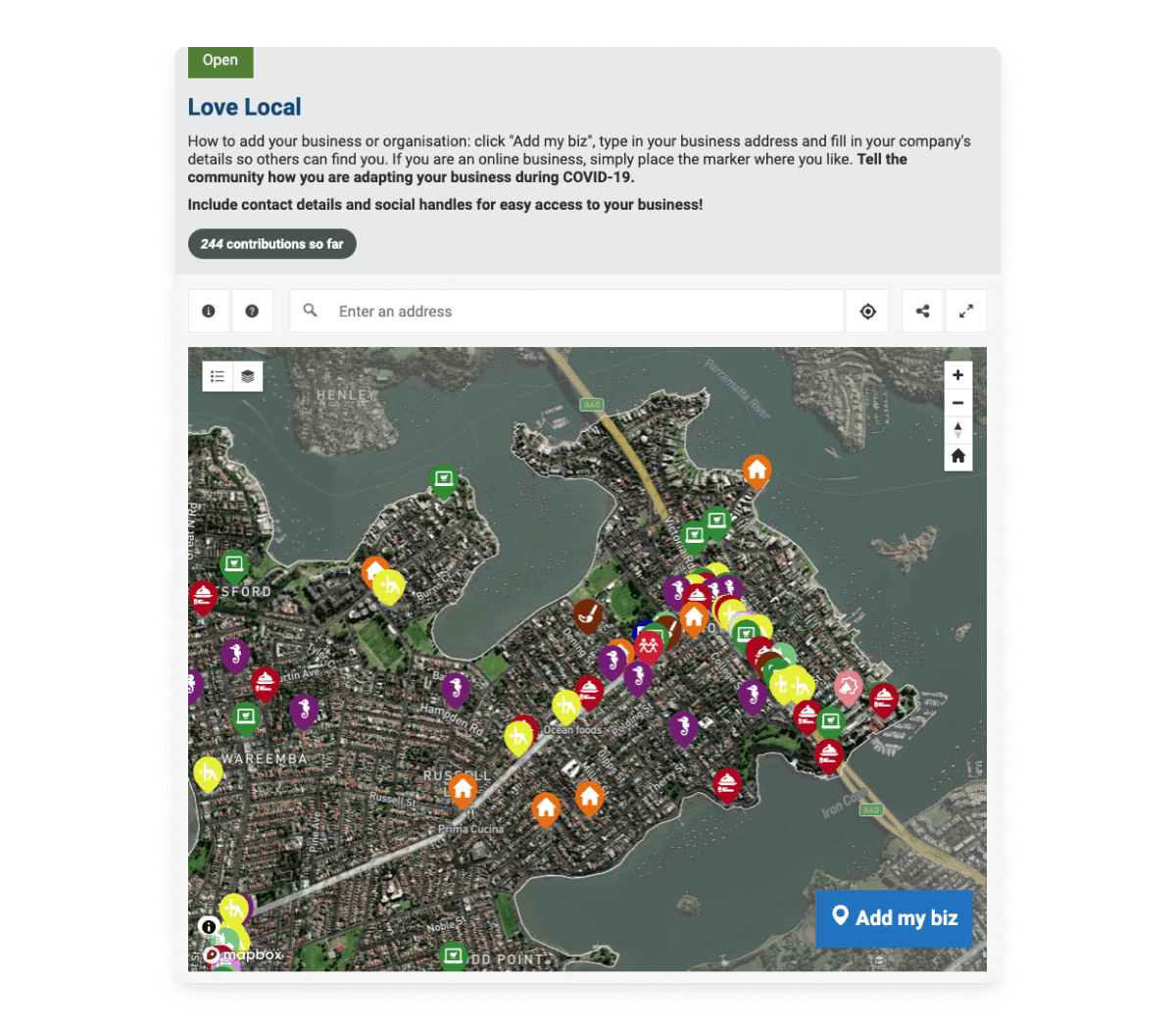
In light of COVID-19, the City of Canada Bay implemented a campaign known as ‘Love Local‘. The primary objective of this project was to offer support to local businesses in the area of Canada Bay by enabling them to register their address and company information to be featured on a Social Map.
The interactive nature of the Love Local SocialMap aimed to assist the 90,000 residents of Canada Bay in easily locating and actively supporting local businesses during challenging circumstances. By providing a centralized and easily accessible online resource, the campaign played a crucial role in fostering community engagement and reinforcing the resilience of the local economy.
The Love Local still receives contributions from local businesses 3 years later!
City of Canada Bay’s Love Local Social Map
3. Future of Open Spaces
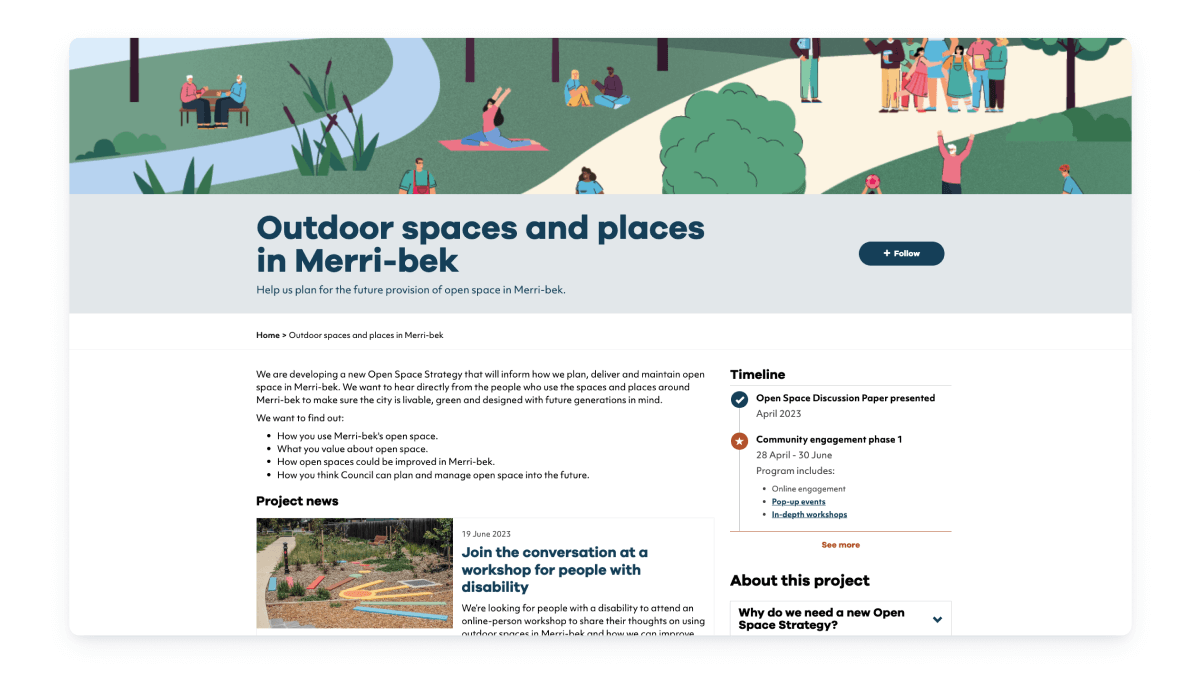
Merri-bek City Council has developed an inspiring project aimed to empower the community in shaping the future of their Open Space Strategy. For this project, the Council wants to hear directly from the people who use the spaces and places around Merri-bek to make sure the city remains liveable, green, and sustainable for generations to come.
By recognizing the importance of gathering input directly from their targeted community through online conversations, Merri-bek aims to receive feedback from the people who use and appreciate these spaces and places to help shape the future.
So far, Council have taken advantage of using a multitude of tools to help create a highly engaging and interactive experience that provides helpful information to guide their community to contribute.
The Council also plans to venture into various local areas by organizing a series of pop-up sessions and in-person workshops. These in-person events are all about bringing the Council staff directly to the community to spark meaningful conversations and gather further valuable insights.
Interestingly, Merri-bek City Council has also pledged to engage community members at the level of ‘involve’. This level of transparency with the community on what level of impact they have on the Open Space Strategy is incredible to see.
“For this project we will be engaging our community at the level of ‘Involve’ on the International Association of Public Participation (IAP2) Spectrum.
This means we will work to ensure the community’s concerns and aspirations are directly reflected in the strategy and provide feedback on how public input influenced the decision.”
Merri-Bek City Council’s Outdoor Spaces Project
4. Wildlife Management
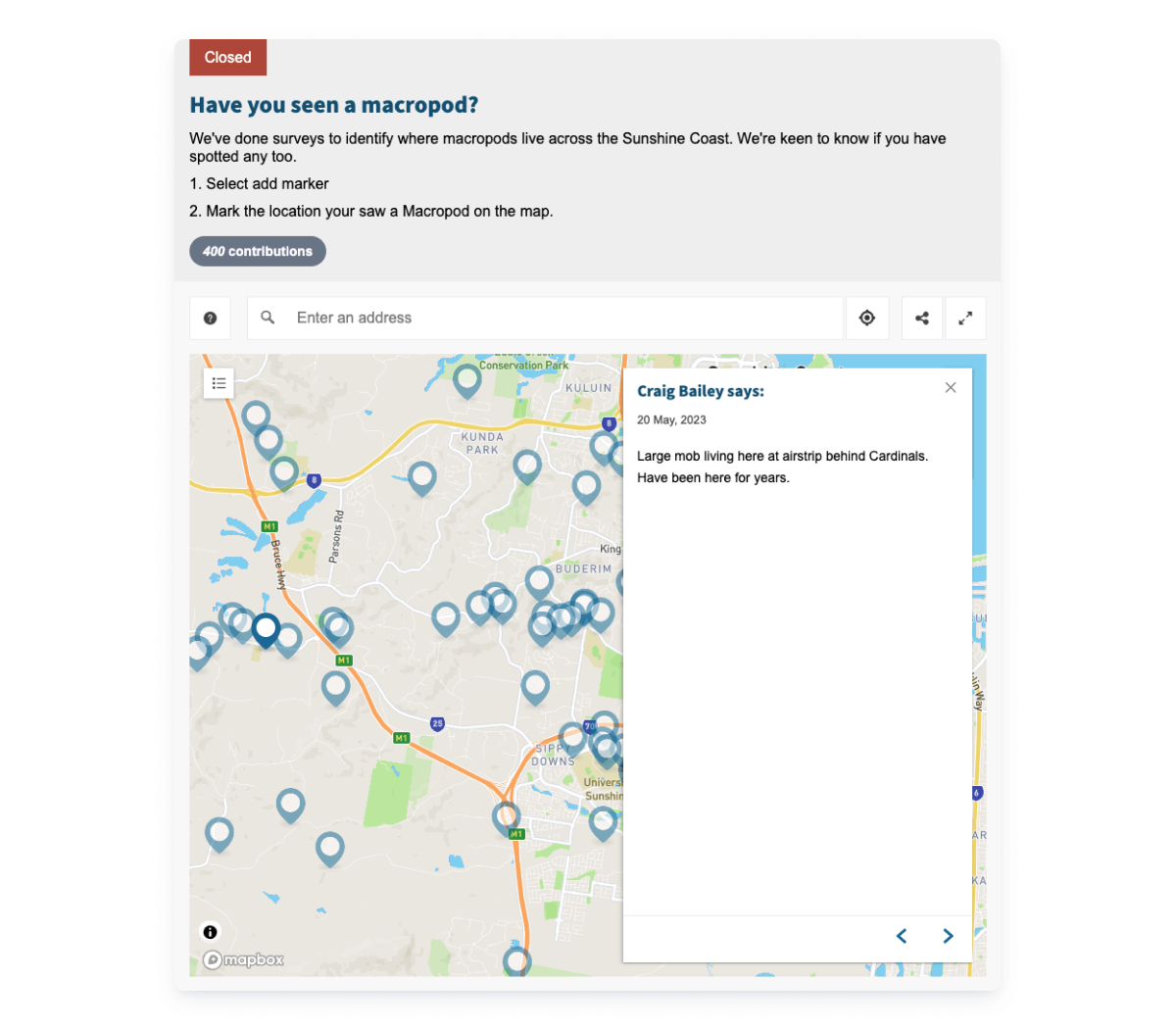
Have you spotted a macropod lately? The Sunshine Coast Council came up with a cool fun project to create a plan in supporting the population of kangaroos, wallabies, and pademelons in their Draft Macropod Conservation Plan.
The Sunshine Coast is home to a beautiful array of native wildlife and the Council recognizes that wildlife management is a shared responsibility across multiple land tenures. Because of this, this project really highlights the importance of partnerships with all stakeholders across the Sunshine Coast to contribute to this plan.
So, to gather some valuable data and input from their community, the Council conducted a fantastic survey using the Form tool to help identify priority actions for the next three years. Alongside their survey, Council also released a Social Map to encourage the community to identify where macropods live across the Sunshine Coast.
This project is a great example of balancing essential community feedback with a variety of interactive elements that spark further interest and intrigue to encourage participation. By providing an opportunity for the community to voice their thoughts, the Council aims to foster a sense of shared responsibility and solidify the long-term well-being of macropods.
Sunshine Coast Council Macropod Map Sightings
5. Crossing the Digital Divide
The City of Calgary created their Digital Equity Strategy to explore and prioritize solutions to reduce the growing digital divide within Calgary’s communities.
The City wants to make concerted efforts so that Calgarians have the necessary technology access, tools, and skills to work, study, and connect online. The initiative builds upon the existing work on Smart Cities and Resiliency, focusing on closing the divide and strengthening the community’s social and economic fabric.
The Digital Equity Strategy goes beyond identifying challenges; it’s about taking action. From their collaborative brainstorming sessions with the community, the City of Calgary required community input to prioritize 17 actions.
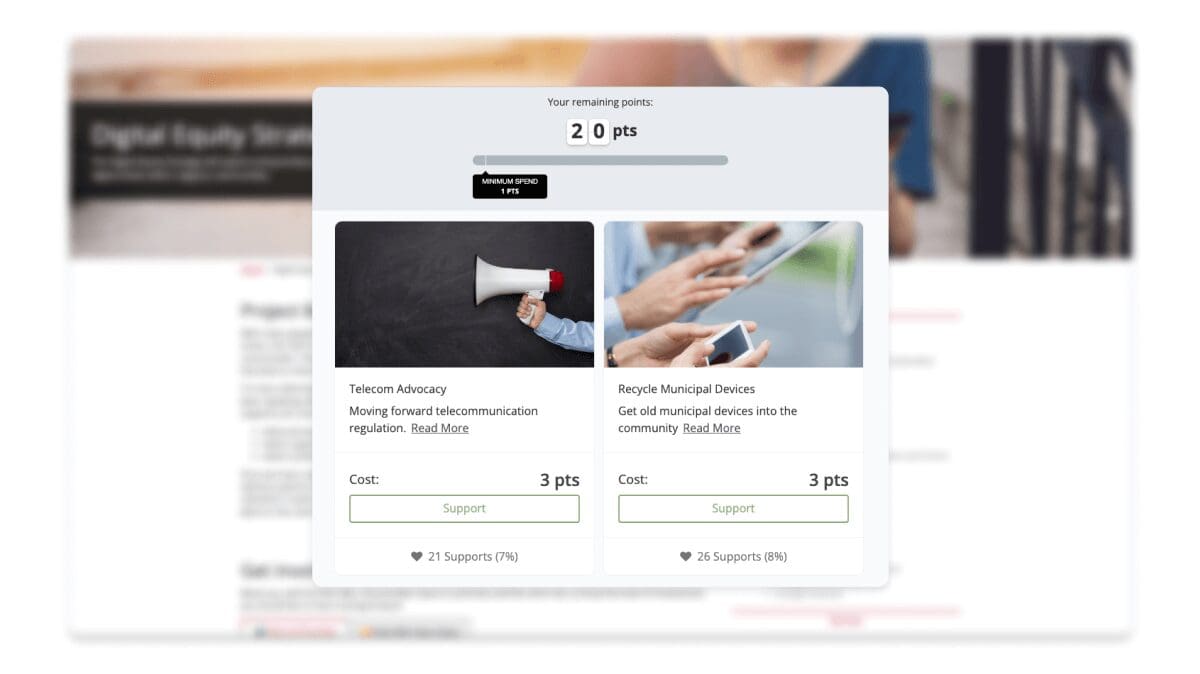
Using the Fund It tool, the City provided the community with 20 points to virtually “fund” their top priorities. With most actions requiring anywhere between 1-5 points to fund, Calgarians were forced to make a trade-off and prioritize the initiatives most important to them.
This interactive process empowered the community to actively shape the Digital Equity Strategy to make Calgary more digitally inclusive, so that everyone can thrive in their living, working, playing, and personal growth experiences.
Example of City of Calgary’s Fund It Tool
How to Create Fun and Interactive Community Engagement Projects?
As a community engagement practitioner, you hold the key to creating fun, interactive, enjoyable, and memorable experiences for community members. The one rule here is to actually try and break the rules of your usual, standard engagement template.
You need to try and break the norm of what your community expects and create an experience that encourages participation.
What tool have you never used before? Could you use images or icons to relay text better? Is there a fun project you could test?
When you break down the barrier of formal participation, you can also create a friendly collaborative space to foster trust, open communication, and mutual understanding with your community.
This lays the foundation for shared decision-making and a greater sense of ownership and camaraderie among community members, ultimately leading to a more inclusive and vibrant community.
In today’s digital world, online platforms and digital engagement tools have played a significant role in connecting communities closer together with their local and federal governments. As we continue to connect with our communities and capture private and personal data the need for understanding the impact of data protection and privacy in community engagement is essential.
Community engagement facilitates meaningful interactions by giving community members a voice to support decision makers in making better informed decisions.
So, as individuals are increasingly relying on online engagements for public participation and communication, it’s important for organizations to ensure that data protection and privacy are one of their main priorities.
But with the rise of digital technology and as more personal data is being shared and collected during online consultations, you might begin to wonder… Where is my information is going? Is my data being protected?
In this article, we will discuss the importance of data protection and privacy in community engagement by providing valuable insights into how organizations handle your data, so you can feel more confident in the safety and security of your personal information.
Why is data protection and privacy important in community engagement?
Making sure that personal data is safe and secure is not only a fundamental right but also essential in the context of community engagement.
Organizations need to assure their community that sensitive information is kept safe as they promote their dedication to creating a secure and trustworthy environment by ensuring data protection and privacy is a top priority.
Implementing robust data protection measures not only aids to fulfill legal obligations but it also creates a welcoming and respectful environment where everyone’s worth is recognized.
Protecting sensitive data by taking preventative measures to safeguard this information is essential. Implementing procedures like data encryption, access control, physical protection, and pseudonymization ensures an appropriate level of security in accordance with these associated risks.
Adhering to legal frameworks and regulations for data protection.
Data protection and privacy are critical considerations for organizations. Fortunately, legal frameworks and regulations have been implemented worldwide to help support these concerns. These regulations generally require organizations to be transparent and secure in how they handle their information
As a community engagement practitioner, you need to ensure that you are adhering to the relevant frameworks and regulations in your region.
Key principles of data protection.
While there are many different legal frameworks around the world, these regulations are usually governed by certain key privacy principles. When it comes to global regulations, it’s important to keep certain key principles in mind for your community engagement process.
GDPR’s 7 key principles provide a fantastic overview on morals and ethics your organization should uphold throughout your consultation period:
Lawfulness, Fairness, and Transparency: Process personal data legally and transparently.
Purpose Limitation: Collect data for specific purposes and avoid incompatible processing.
Data Minimization: Collect only necessary and relevant data.
Accuracy: Ensure personal data is accurate and up to date.
Storage Limitation: Retain data for the necessary duration and delete it when no longer needed.
Integrity and Confidentiality: Implement security measures to protect personal data.
Accountability: Demonstrate compliance with the GDPR and maintain records of processing activities.
Here’s an example that demonstrates the implementation of Lawfulness, Fairness, and Transparency:
A local government decides to conduct a community survey to collect feedback on upcoming infrastructure projects. To ensure transparency, they explicitly communicate the purpose of the survey, explain how the data will be utilized, and clarify the legal grounds for processing participants’ data. They provide transparent information on data protection measures, such as anonymizing responses and ensuring data confidentiality.
By following these steps, the local government ensures compliance with the GDPR principle of Lawfulness, Fairness, and Transparency. They prioritize open communication, respect participants’ rights, and provide clear information on how data is collected, used, and protected.
As you can see, these principles help organizations safeguard individuals’ privacy and adhere to global regulations.
Ensuring your community engagement platform is private, secure, and safe.
When utilizing online platforms for community engagement, it is essential to prioritize privacy to safeguard sensitive information and foster a trusted and secure environment for community members to participate and interact. Consider the following measures:
Secure Infrastructure
Community members can choose reputable platforms that employ robust security measures, such as encryption, to safeguard their user data. Social Pinpoint, for example, is ISO 27001 Certified, achieving the highest standard of security, safety, and support.
Private Projects, Anonymity and Pseudonymity
Offering private projects or the choice to participate anonymously/using pseudonyms can help you can create a safer space for community members to participate in a more closed environment. This fosters a sense of comfort and feeling more secure by eliminating concerns about identification.
Citizen Membership
Citizen memberships often entails a verification process to ensure that community members are genuine and accountable for their actions. This helps maintain a safer and more trustworthy environment for community members within the platform. With Social Pinpoint, you can build a flexible and customizable user registration system to capture members.
Access Controls
User permissions enable your organization to control access and make sure that only the appropriate people can view and update sensitive information. Access controls are a great way of lowering the chance of unauthorized leaks or data breaches. Social Pinpoint has a sophisticated user management system that lets users control and manage all users and their levels of permission and access.
Next steps to implement better data protection and privacy.
Data protection and privacy are paramount considerations when engaging communities.
Make sure your privacy policies are easy to find and understand. Let people know exactly how their personal information is treated, stored, and shared. And ensure you establish channels for community members to ask questions, voice concerns, and request modifications or deletion of their personal information.
By adhering to data protection frameworks, following key principles and keeping security top of mind, you can feel more confident that your community engagement data is safe. And, by taking these additional steps to maintain the privacy of your community members, you can instill greater confidence that they’re safe too.
Video is an extremely powerful tool to instantly capture the attention of your community and increase connection on a deeper level. With interactive and visual content being consistently preferred over traditional, text-based, or static media, it is no surprise that video content should be prioritized. In community engagement, video can transform a project and enhance information delivery – so here are 5 reasons why your team needs to use video content in community engagement.
According to a study republished by Forbes, “91% of consumers now prefer visual content over traditional, text-based or static media.” The versatility of video content makes it an effective tool for engaging diverse audiences with different interests and needs. It’s no surprise that video is becoming an incredibly popular and powerful tool for community engagement.
Videos are a great way to connect and engage your community by offering informative, insightful, emotive, or entertaining information. You see, videos are versatile and can be used in a variety of ways, from promoting community events and initiatives to providing educational resources or sharing personal stories. However, it’s important to understand the value of video and how it can help you improve your community engagement.
Also just a quick disclaimer, video content doesn’t have to be some big, outlandish production piece. Simply having a face or voice behind your project is a great start! So, what type of video content should you be focusing on?
What video content should you use?
Video content can come in various formats, which can include tutorials, vlogs, animated GIFs, live videos and webinars, recorded presentations, or even community stories.
Tutorials are designed to educate viewers on completing a task or performing a skill. We’ve seen some great examples of our clients showing exactly how to provide feedback if they’re testing out a new participation method.
Vlogs typically feature a person sharing their personal experiences or opinions on a topic. Sometimes an expert in the team can provide a more in-depth breakdown of a project.
Animated GIFs are short, looping video clips often used for comedic effects or to convey a quick message.
Live videos and webinars offer real-time interactions with viewers and allow you to have a conversation surrounding a specific topic or project. Already had a Virtual Town Hall? Great, share that recording on your project page and allow everyone to view!
Recorded presentations are pre-recorded discussions designed to be watched later. These videos can help provide a more structured approach to complex information.
Community stories feature individuals sharing their experiences and insights.
You may successfully deliver your message and engage your audience in a way that coincides with your communication objectives by selecting the best video format for your project.
Why you need to use video content in community engagement.
Video content is powerful and can be used to enhance your community engagement efforts. There are five key reasons why you need to be using video content, let’s take a closer look:
Your community will absorb information easier.
Your engagement team can repurpose more content.
The SEO of your engagement project will improve.
You will increase engagement, a lot.
Your community trust and connection will soar.
1. Your community will absorb information easier.
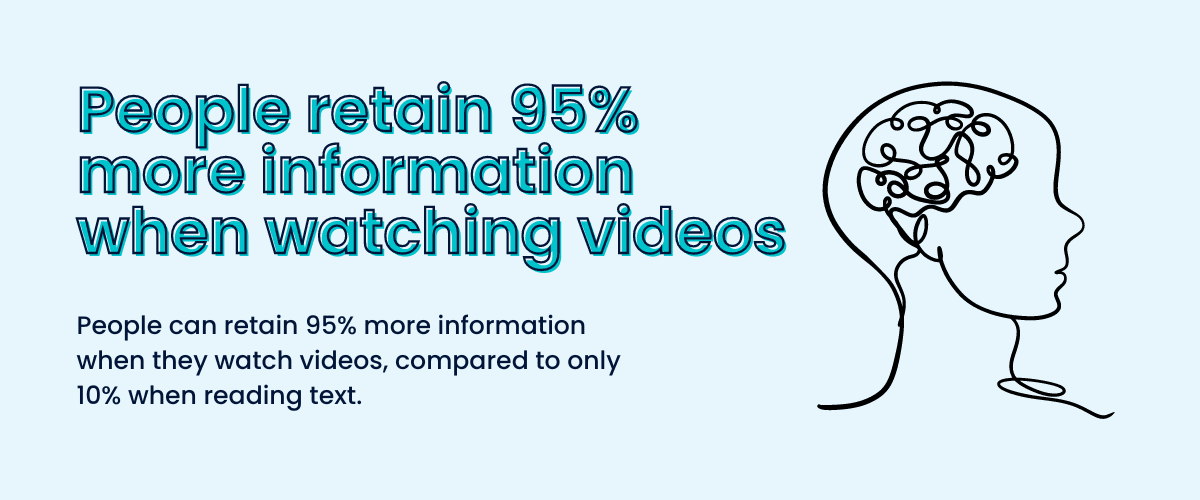
Did you know that people obtain information easier through visuals than by reading plain ol’ text? According an Insivia 2023 Marketing Report, people can retain 95% of information when they watch it in a video format, compared to 10% when reading it in text.
Videos are a type of storytelling that allows you to combine information into a short narrative to bring attention to your community in a manner that text cannot. Rather than simply listing facts, you can make your content more memorable by providing information to help you engage with your community on a deeper level.
A significant amount of text translated into a brief video with a representative speaking on a project provides another avenue to reinforce your message and to better connect with your community. The more educated your community is and understands what’s happening around them, the more input they will bring to aid you in making better-informed decisions.
2. Your engagement team can repurpose more content.
Are you ever stuck for content ideas? Videos are excellent for repurposing opportunities, as they can be utilized in different ways to give your content a fresh new life. Community engagement practitioners can repurpose video content by creating short clips or a series that focuses on specific aspects of a project you’re working on.
For example, have you already hosted an online event or town hall? If so, then you can easily upload a copy of this to your project to help provide more context and information. These videos may then be shared on your social media, website, or even email newsletters to increase interest and engagement from members of your community.
You can also transform your lengthy project text into presentations or webinars to educate your community further on the project and provide a new layer of visual context.
3. The SEO of your engagement project will improve.
Improving your project’s site ranking with SEO (Search Engine Optimisation) techniques is incredibly helpful for community engagement as it can increase the visibility of your online presence, making it simpler for your community to participate and connect. Search engines (such as Google) prefer websites with video content and rank them 53 times higher than those without.
Video can increase the length of time people spend on your site, which will lead to longer engagement times overall. This is also a positive SEO indicator as Google will deem your content relevant and of high quality to your audience.
Uploading a transcript or subtitle file to your video can also boost the SEO and discoverability of your project whilst also providing more accessibility options for members of the community.
4. You will increase engagement, a lot.
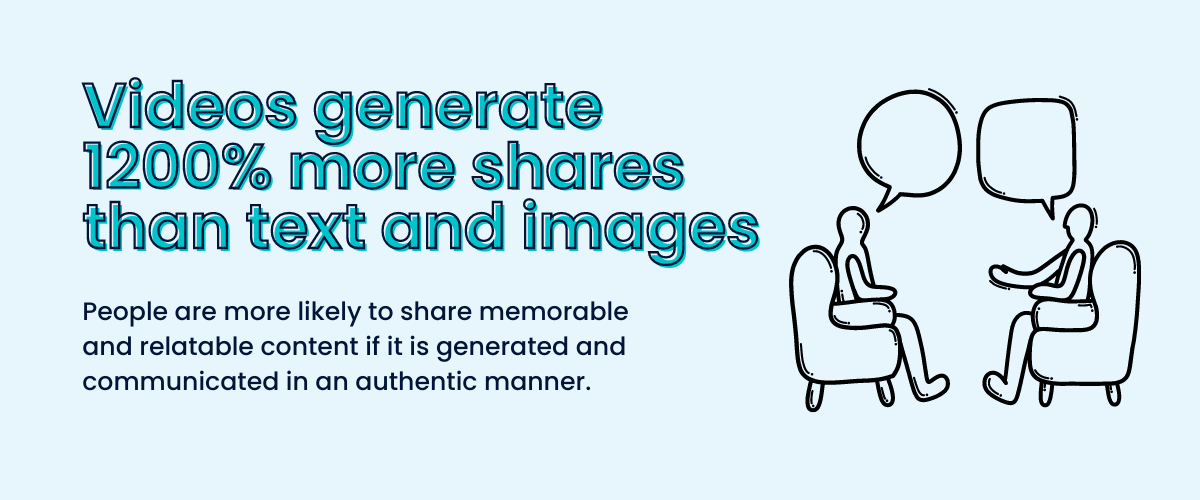
Using video content increases the likelihood of generating an emotional response from members of the community. People are more likely to share memorable and relatable content if it is generated and communicated in a memorable and relatable manner. According to Forbes, videos can generate 1200% more shares than text and image content combined.
Video provides an additional avenue for the community to connect, be informed, and understand more about a project. Especially, if there is a physical change or shift that the public can see being built or developed, then a video can really help to envisage that.
Thankfully, Social Pinpoint’s flexibility allows video content to be embedded anywhere within your project. This will optimize your engagement for different levels of information and understanding as you can decide exactly where your video is located.
Video also provides the opportunity to introduce new engagement tools that the community might not be used to. If you’re looking to expand on the typical survey for example and use a budgeting tool, you can show your video exactly how to contribute feedback and what that will be used for.
5. Your community trust and connection will soar.
Videos are great for showing transparency, as your audience can observe the body language and tone of the speaker, which builds credibility. When it comes to adding a face behind those who are delivering a project, it creates a sense of emotional connection and builds trust. Videos can demonstrate the knowledge and expertise of a person or the organization behind the content by presenting information in a clear and simple manner, which also increases trust and legitimacy.
To put it simply, video marketing is a powerful tool for community engagement, as it provides an effective approach to interact and engage with your audience, through the use of visuals.
Video helps people remember more. Not only is it a powerful tool for helping people further understand and remember your organization, but it generally outperforms other content. Recently, HubSpot described just how insanely popular (and powerful) it is with more than nine out of 10 people reporting they want to see more videos from organizations in 2023.
Video helps build better community connection. Video allows you to use a combination of visual and auditory elements to convey emotions, ideas, and stories in a way that static, complex content cannot. Because of this, you are able to help viewers understand the people and issues involved in a community initiative, making it more likely they will feel invested in and motivated to contribute feedback.
Social media can be used to promote public engagement opportunities and educate the community. However, governments and organizations may need to set up a more controlled environment in order to hold deeper and more informed community-led conversations. Before you start using social media for public engagement, here are 3 considerations you should make.
However, if you are trying to have an important conversation with your community and gather meaningful feedback from specific groups of people, there are a number of inherent social media risks that need to be accounted for.
Here are three considerations to make before you start conducting public engagement through social media.
Your engagement strategy will be restricted to the design, tools, and rules of the social media platform.
You will have limited control over the conversation.
It will be difficult to gather meaningful insights.
1. Your engagement strategy will be restricted to the design, tools, and rules of the social media platform.
Online public engagement platforms are designed differently from social media platforms. Social media algorithms favor popular or personally relevant content within people’s feeds. When you’re engaging with the public in your own digital engagement platform, you can present the information that needs to be heard.
Can you provide an accessible space for diverse citizens?
You can also tap into accessibility features that give diverse citizens an equitable opportunity to gather information or join a conversation. Whereas, on social media, you can only use the features that are available on that platform.
If the platform isn’t easy to use or the translation tools are inaccurate, then you could be excluding various community members from participating.
Does the public feel safe to openly share their opinion?
On most social media platforms, people usually have to create an online profile to join, and openly sharing an opinion on a divisive topic can open them up to online bullying and have implications for other areas of their lives. Some community groups prefer to have privacy or anonymity before contributing to a conversation, meaning that a digital engagement platform will be required for them to participate.
So, before you decide to engage the public via social media you need to question whether the design, rules, and tools of the platform are conducive to a meaningful dialogue.
2. You will have limited control over the conversation.
If you try to engage with citizens on social media, remember that your message may be lost or confused within the huge volume of social media posts. Audiences are also fragmented across multiple platforms, so need to have an integrated promotion strategy to ensure that you reach everyone.
Are you able to keep the conversation positive, relevant, and respectful?
It can be difficult to get citizens conversing about a topic in a structured and organized way in this environment. It will also be harder to maintain respectful dialogue because many social media platforms take a ‘freedom of speech’ stance.
That means that it’s easy for harmful views to stifle participation. It’s also easy for misinformation to spread quickly because people can post and share their opinions with limited moderation. Social media platforms can also amplify the loudest voices in the room because they create higher engagement, which means that you can miss out on valuable opinions.
Will your messaging remain effective?
Your messaging will also need to fit within the posting parameters of the platform, often meaning that it has to be quick, brief, and compelling – which doesn’t always favor nuanced discussion about challenging topics.
They also have moderation interfaces that allow you to approve, reject, and refer content, as well as automated filters for profanities. They keep the conversation flowing in one place, rather than across countless pages, profiles, channels, and platforms where it’s impossible to connect the dots and make meaningful decisions.
The best public engagement platforms also include 24/7 human moderation so you can rest easy knowing that all public contributions are kept safe, respectful, and on topic.
3. It will be difficult to gather meaningful insights.
Conversations can get fragmented across social media platforms, resulting in disconnected reporting. Many social media platforms also monitor engagement metrics and trending topics so that brands or influencers can build their presence.
Decision-makers need to conduct deep research in order to address many of the issues that are in front of them, and it’s impossible to get representative insights in environments that favor the loudest voices.
By pooling the conversation in one digital engagement platform, it’s easier to gather meaning. It’s also possible to look at past projects to understand sentiment and community impacts, providing historical context that couldn’t be gained by trawling through data scattered across multiple social media platforms.
Can you connect more meaningfully?
Social media platforms are a great avenue for keeping the public involved and promoting engagement opportunities. However, if you want to engage more deeply, then it’s important to direct people toward a dedicated engagement platform that can foster productive and inclusive conversations between people from all different walks of life.