2025 has been a defining year for community engagement.
Across regions, updated policy requirements and rising expectations for transparency and follow-through pushed engagement practices to mature. At the same time, evolving digital tools reshaped how organizations connect with communities, supporting more meaningful, two-way participation.
This year-in-review brings together key engagement trends from 2025 across Social Pinpoint’s core regions, informed by real-world project experience, ongoing conversations with practitioners, and insights shared at conferences, workshops, and peer-led forums. Viewed side by side, these trends reveal how engagement is evolving—and what that means as organizations prepare for the next phase of practice.
North America: 2025 Community Engagement Insights
At a glance:
Budget engagement became more deliberate and education-focused
Organizations focused on visibility of plans, even after adoption
Exploratory hubs emerged as a primary way residents navigate engagement
Engagement became more embedded into organizational culture and practice
1. Budgets Took Center Stage
In 2025, financial pressure became a defining backdrop for public engagement across North America. Budget constraints, funding uncertainty, and rising service demands converged with growing public expectations for transparency. Residents increasingly wanted clearer insight into how public dollars are allocated, how trade-offs are made, and the long-term impacts of those decisions.
In response, we saw a clear uptick in budget-focused engagement. Rather than asking residents to react to final numbers or high-level summaries, however, organizations created more intentional opportunities for learning before input. Engagement increasingly focused on helping participants understand priorities, constraints, and trade-offs so they could contribute with greater context and confidence.
Digitally, this shift was reflected in a move away from text-heavy surveys and static budget documents toward participatory budgeting tools designed to make complex financial decisions easier to understand. Interactive allocation exercises, visual trade-off scenarios, and map-based activities helped translate complexity into experiences that felt clearer, more accessible, and more engaging.
This evolution reflects a growing recognition that budget decisions are inherently complex, and that residents engage more thoughtfully when given tools to explore options, understand constraints, and see the implications of different choices.
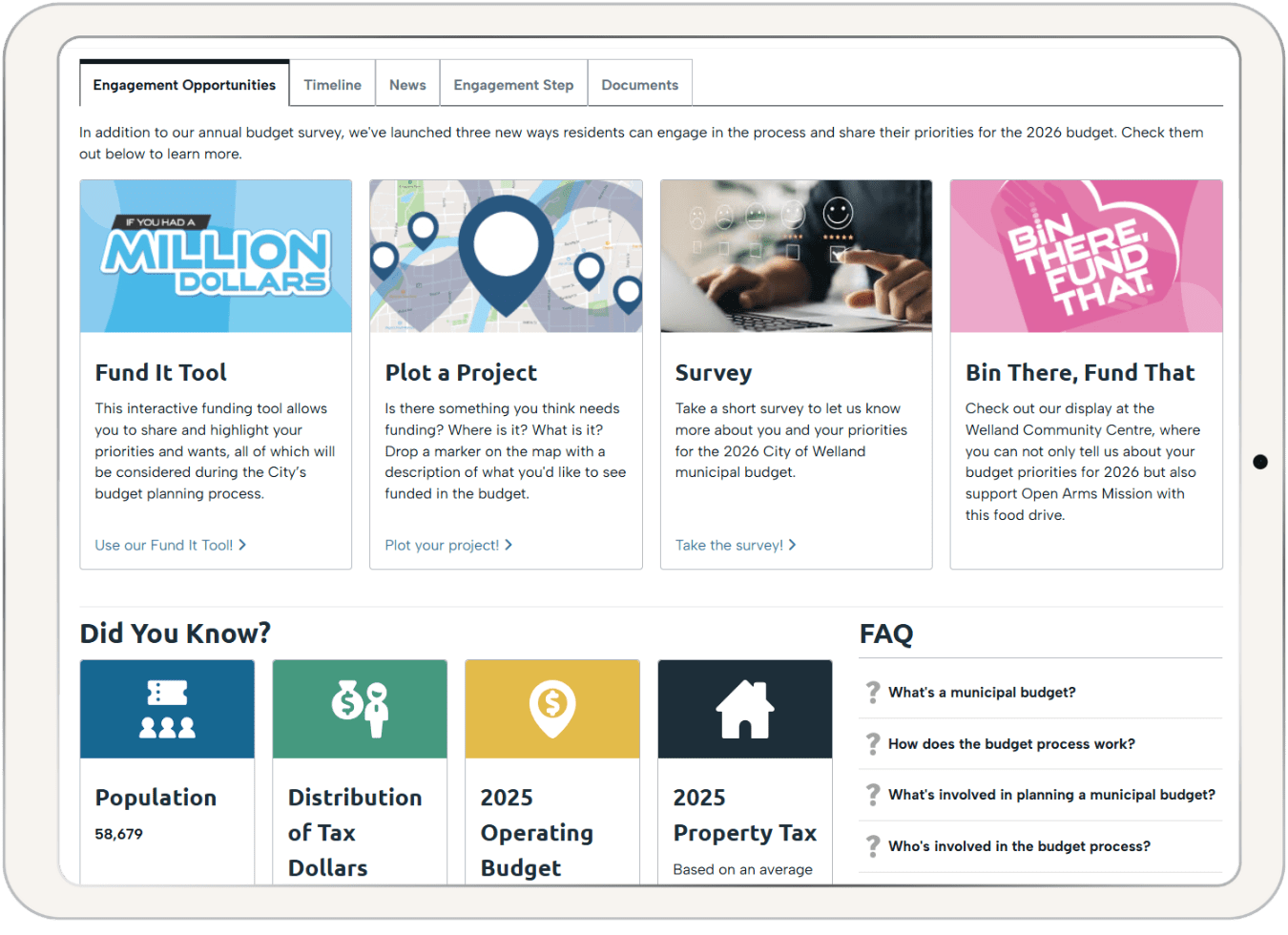
Example: City of Welland | The City of Welland’s 2026 Municipal Budget engagement transformed a traditionally technical topic into an interactive experience residents could actively participate in. Through multiple entry points, including allocation exercises, mapping activities, and visual surveys, the city emphasized education alongside input, creating an experience that felt approachable and intuitive.
For our Budget 2026 engagement, we used Social Pinpoint to make the budget process a lot easier for people to take part in. The tools—like Plot a Project and the Fund It allocation exercise—gave residents simple, hands-on ways to learn and tell us what mattered to them, instead of just filling out another survey.” — Paul Orlando, Communications Specialist, City of Welland
2. Keeping Plans “Off the Shelf”
In 2025, rising resident expectations increasingly centered on seeing how feedback shaped final outcomes and what happened after plans were approved. In response, practitioners began to rethink engagement as something that extends beyond the point of decision—shifting focus toward how plans live on as active, accessible resources rather than static records of a completed process.
In practice, we saw many organizations move away from simply sharing final plans as single, text-heavy PDF documents that were rarely revisited. Instead, they adopted dedicated digital project pages designed to keep plans visible and relevant over time. These pages brought together final plans, ongoing updates, and supporting information in one place, using visuals, interactive tools, and clear navigation to make content engaging and easy to explore. This approach supported stronger follow-through and more transparent “closing the loop,” helping residents see how their input was used and how plans move into implementation after approval.
Example: Town of Carrboro | The Town of Carrboro’s Downtown Area Plan demonstrates how a traditionally static document can be reimagined as an engaging digital experience. Through visuals, videos, expandable sections, and intuitive navigation, the plan is presented in clear, digestible pieces that invite exploration and make complex information easier to understand.
Example: Town of Innisfail | The Town of Innisfail’s Napoleon Lake South Development project shows how plans can remain accessible over time. The project page presents information in a clear, visual format and uses interactive tools such as Hotspot to help users explore lot pricing, encouraging understanding and repeat visits as the plan develops.
By incorporating the Hotspot tool, we were able to create a more engaging and interactive experience for potential builders and buyers.” — Shelby Veldkamp, Marketing & Digital Media Specialist, Town of Innisfail
3. The Rise of Departmental + Program-Based Engagement Hubs
In 2025, we observed a clear shift toward more structured and intentional digital engagement environments. Rather than organizing engagement solely around individual projects, many organizations began using engagement hubs as the primary way residents enter and navigate engagement online.
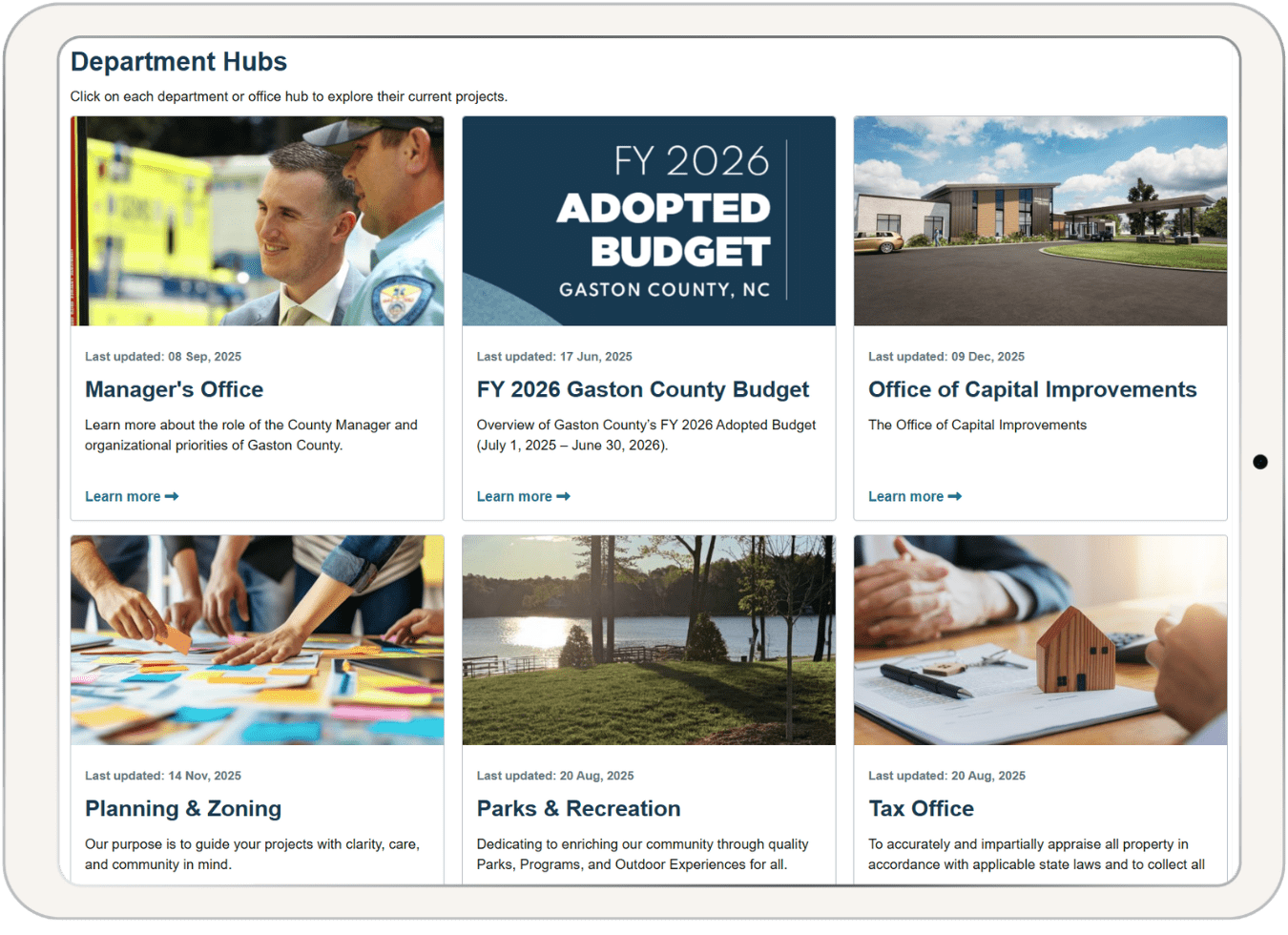
Hubs serve as a central landing point that connects residents to multiple dedicated engagement pages within a single, cohesive structure. In some cases, a single organizational hub links to individual department pages; in others, a regional hub brings together engagement activity for multiple municipalities; and in others, a program-level hub houses several related projects within a broader initiative. Regardless of structure, hubs provide a clear framework that helps residents understand what’s happening before choosing where to engage more deeply.
Example: Gaston County | Gaston County’s Engage Gaston platform illustrates how a department-based engagement hub can bring clarity and continuity to ongoing engagement. The central hub introduces residents to the county’s engagement efforts at a high level, while department-specific spaces allow people to explore each department’s role, learn about current initiatives, and follow engagement opportunities in a consistent, easy-to-navigate format.
4. Maturing Organizational Engagement Cultures
Our final North American observation points to a broader maturation of community engagement as a professional discipline. Even amid tight budgets and competing priorities, more organizations are moving beyond ad hoc or project-by-project approaches and embedding engagement more deeply into organizational culture, decision-making processes, and long-term planning.
This shift is reflected in how teams are resourcing engagement internally. Organizations are clarifying responsibilities, establishing shared practices, and increasingly creating or expanding dedicated engagement roles. Engagement is being positioned less as a supporting activity and more as a core organizational function.
Alongside this maturation, we observed a growing emphasis on continuous reflection and learning. Organizations are regularly assessing whether engagement goals are being met, where gaps exist, and how approaches can adapt over time. More frequent internal reviews, peer learning, and an emphasis on iteration signal a field that is becoming more strategic, accountable, and confident in its role within public decision-making.
Industry Signal: IAP2 North American Conference | At the 2025 IAP2 North American Conference, Social Pinpoint Practice Leads facilitated a panel with practitioners from the City of Fort Wayne, the City of Ann Arbor, and the City of Durango (2025 IAP2 Organization of the Year). Discussions focused on how organizations resource engagement and move beyond “checking the box” toward more intentional, organization-wide approaches—highlighting a strong appetite for practical guidance, peer examples, and strategies for sustaining engagement amid competing priorities.
ANZ: 2025 Community Engagement Insights
At a glance:
Registration became a more intentional tool for trust, accountability, and data quality
Participatory budgeting and funding tools gained traction
Design approaches placed greater emphasis on neurodivergent inclusion
Engagement moved beyond one-off projects toward continuous, infrastructure-based models
1. Rethinking Registration
In 2025, registration—asking participants to identify themselves before taking part—became more common and more deliberately applied across online community engagement in Australia and New Zealand.
This shift was shaped by a mix of legislative, policy, and accountability considerations. Updates to Local Government Acts, stronger transparency and reporting requirements, and the rollout of gender equity and inclusion frameworks raised expectations around who is engaged and how participation is evidenced in decision-making. At the same time, engagement teams faced growing internal expectations to demonstrate reach, representation, and follow-through, making structured participant data more important.
In practice, registration was handled with greater clarity and transparency. Organizations placed greater emphasis on explaining why registration is required, how participant data will be used, and how privacy is protected. Clear communication around purpose, value, and data use became essential to reducing friction, building trust, and maintaining participation, particularly when engaging on sensitive or high-impact topics.
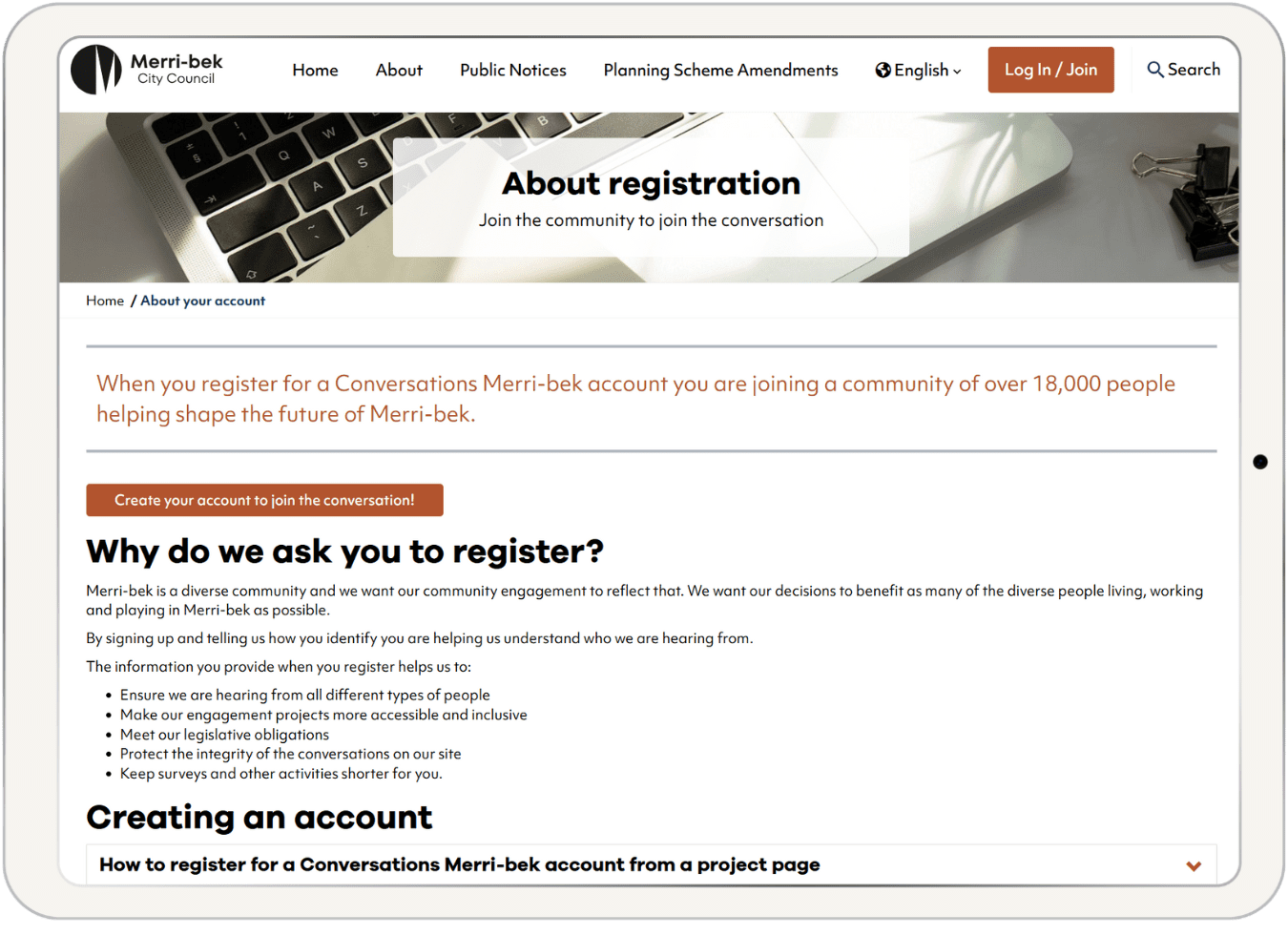
Example: Merri-bek City Council | Merri-bek City Council adopted a transparent approach by creating a dedicated “About registration” page that clearly explains why registration is requested and how participant information is used and protected, helping residents understand the value of registering before taking part.
2. Participatory Budgeting and Creative Use of Funding Tools
Participatory budgeting and the creative use of digital funding tools gained momentum across Australia and New Zealand in 2025, reflecting similar shifts observed in North America. Councils faced increasing expectations to demonstrate transparency, fairness, and accountability in how resources are allocated, particularly where funding decisions intersect with equity, access, and long-term community outcomes.
Regional policy and strategic frameworks encouraging more inclusive decision-making further reinforced this trend. In response, many councils adopted interactive digital tools that allow residents to explore priorities, test scenarios, and allocate funding across projects or service areas, moving beyond traditional consultation approaches.
These tools helped demystify budgeting by turning abstract figures into tangible choices. By visualizing trade-offs and constraints, residents were better able to understand how funding decisions are made and provide input grounded in real-world conditions rather than reacting to numbers in isolation.
Example: Canterbury-Bankstown Council | Canterbury-Bankstown Council’s budget engagement illustrates this trend in practice. Using an interactive budgeting tool, residents were introduced to the council’s $400+ million annual budget and its core service areas, then invited to allocate funding within a simplified model scenario, helping the council better understand community priorities and preferences.
3. Neurodivergent-Inclusive Engagement Design
In 2025, we also observed increased attention across Australia and New Zealand on designing community engagement that better supports neurodivergent participants. Growing awareness of neurodiversity, alongside stronger inclusion and accessibility expectations in public-sector frameworks, prompted organizations to look beyond minimum accessibility standards and consider how design choices affect participation quality.
In practice, this included clearer language, reduced cognitive load, multiple ways to participate, longer engagement windows, and formats that allow residents to engage at their own pace. We also saw increased use of visual supports, short-form content, and alternative formats, such as audio or video explanations, alongside text. More organizations also gave participants greater choice and control over how they engaged, allowing people to dip in and out of activities, complete sections independently, or focus only on topics most relevant to them.
Example: Maribyrnong City Council | The Maribyrnong City Council Youth Hub demonstrates how thoughtful design choices can support more inclusive participation. Plain language, short sections, clear visual cues, and flexible participation options helped create an environment that supports different ways of processing information and enables more young people to engage meaningfully.
4. Continuous Engagement as Infrastructure
Our final ANZ observation points to a shift toward treating community engagement as ongoing infrastructure rather than a sequence of stand-alone projects. Instead of resetting engagement with each new initiative, organizations increasingly designed approaches that support continuity over time, allowing participation, context, and follow-through to build rather than restart.
In practice, engagement began to function more like a shared, evolving resource. Insights gathered during early stages were carried into later phases, and residents could see how previous input shaped subsequent decisions. Context was preserved rather than reintroduced, reducing the need to repeatedly explain issues or rebuild trust and helping engagement feel cumulative and purposeful.
This shift was reflected in how digital engagement was structured and maintained. Online platforms increasingly stayed active beyond individual project timelines, with updates, outcomes, and next steps added over time. Previous feedback and background materials remained visible, supporting clearer “closing the loop” and enabling residents to follow issues as they evolved. Engagement teams also focused more on continuity, emphasizing updates, accountability, and ongoing participation rather than treating engagement as a one-time task.
Example: City of Port Adelaide Enfield | The City of Port Adelaide Enfield’s multi-year Get Shady tree-planting initiative illustrates how continuous engagement can support long-term outcomes. Since 2022, the program has engaged residents over multiple years, connecting individual participation to broader climate adaptation goals and reinforcing engagement as an ongoing partnership rather than a one-time interaction.
Looking Ahead: Building on the Shifts of 2025
Across both regions, engagement shifted away from one-off, check-the-box consultation toward approaches designed to build understanding, trust, and continuity over time. Budget engagement became more education-focused, clearer follow-through showed how input was used, and engagement increasingly functioned as an ongoing system rather than a single event. While these patterns took different forms across North America and ANZ, the underlying intent was consistent: to make engagement more meaningful, transparent, and closely connected to decision-making.
At the core of this evolution is a broader maturation of engagement practice. Organizations are moving from event-based interactions to systems of trust; from inclusion as compliance to inclusion as design; and from collecting feedback to demonstrating follow-through. Engagement is increasingly treated as a core capability, embedded into how organizations plan, decide, and communicate.
Looking ahead, this trajectory is likely to continue. As policies evolve, digital tools advance, and expectations for transparency increase, engagement will become more deeply integrated into decision-making processes. Continued emphasis on inclusive and accessible participation—and greater investment in continuous engagement models over isolated consultations—will support more sustained, two-way dialogue with communities.
For organizations planning ahead, the opportunity lies in building on this momentum: prioritizing clarity over complexity, designing engagement that supports different levels of participation, and investing in systems that offer engaging, user-friendly ways for residents to take part while remaining active over time. As the field continues to mature, the organizations best positioned for what’s next will be those that treat engagement not as a moment in time, but as a capability that evolves alongside their communities.
Explore These Trends in More Detail
Want to dive deeper? The 2025 engagement trends highlighted above were explored further in Social Pinpoint’s 2025 Year in Review webinars, showcasing real-world examples designed to inspire new thinking and help you carry these approaches into your own work.
This recognition underscores Durango’s work to foster a culture of engagement rooted in collaboration, trust, and transparency, where community voices play a central role in shaping local decisions and opportunities to participate are accessible, inclusive, and impactful.
At Social Pinpoint, we’re proud to support Durango on this journey and are thrilled to see their commitment to meaningful public engagement celebrated on a global stage.
Investing in People and Processes
Effective public engagement requires more than good intentions—it demands deliberate investment in both personnel and processes. Recognizing this, the City of Durango set out to build a program capable of reaching the entire community, fostering trust, and creating genuine opportunities for residents to participate.
A cornerstone of this effort was the creation of a Community Engagement Specialist position, tasked with reimagining the City’s approach to public participation and addressing long-standing challenges such as fragmented outreach and inconsistent communication.
Funding this pioneering role marked a pivotal moment in Durango’s commitment to transparent, inclusive engagement. The position filled a critical gap between leadership, staff, and the public, providing the expertise needed to build a modern engagement program from the ground up—designed to break down barriers, rebuild trust, and create two-way channels for resident input through surveys, workshops, and online platforms.
By positioning the Community Engagement Specialist within the City Manager’s Office, Durango ensured staff training, coordinated focus groups, aligned messaging, and established clear pathways for resident participation. Creating this shared understanding of project goals internally allows residents to receive consistent, clear information, making every opportunity to engage more accessible, meaningful, and impactful.
Engage Durango: A Digital Hub for Community Input
Building on stronger internal coordination and a shared vision for engagement, the City of Durango took the next step: expanding into digital participation.
The launch of Engage Durango, Durango’s Social Pinpoint-powered online engagement hub, marked a pivotal moment in centralizing community input and modernizing the way residents interact with local government. The platform allows residents to explore projects, stay up to date on initiatives, and provide feedback on their own terms, offering a user-friendly, interactive experience that makes participation both accessible and engaging.
Intuitive search, filter, and sorting options across 12 categories help users find projects that align with their interests. Projects are organized into three stages: open (currently requesting feedback), active (in development or construction), and closed, which gives residents a clear view of the lifecycle of local initiatives.
With more than 40 interactive tools at their disposal, Durango staff can tailor each project page to the specific needs of the initiative—whether collecting quantitative data, qualitative insights, or spatial feedback. This flexibility ensures each engagement opportunity is aligned with project goals while creating an experience that encourages residents to participate and return for future input.
In its first year alone, Engage Durango attracted over 24,000 visitors. Today, the City continues to leverage the platform alongside in-person events and community programs, meeting residents where they are and providing convenient, interactive, and impactful opportunities to share their perspectives.
Creative Engagement and Focused Feedback
To complement its online engagement efforts, Durango has introduced hands-on initiatives that make participation both fun and impactful.
One standout example is Nerds Night Out, a monthly trivia night focused on Durango history and municipal government processes. The event offers a lively way to engage younger residents while also serving as a valuable feedback tool. For instance, a question about a past sales tax reauthorization revealed gaps in public knowledge, helping City staff identify opportunities for clearer communication and civic education.
Another example is Durango’s Neighborhood Walk and Rolls outreach effort, which brings City Councilors directly into local neighborhoods to connect with residents who may not typically attend formal council meetings. These casual, two-way conversations allow residents to share their perspectives on local issues and successes, strengthening community relationships and providing real-time feedback. Locations and times are tailored to community needs, and sessions are designed to be informal, with no agendas or presentations, so residents can speak openly and comfortably.
Durango has also implemented a Focus Group framework as part of its broader engagement strategy. Unlike traditional boards or task forces, focus groups are small, targeted discussions that allow staff to gather diverse perspectives on specific projects, ensuring recommendations are informed by direct community feedback. To remove barriers and foster inclusivity, the City provides translation and interpretation services, childcare, and food at these sessions, helping ensure participation from a wide and representative cross-section of the community.
A New Era of Engagement
The City of Durango has redefined public engagement. It is no longer limited to participation on boards and commissions or treated as a routine formality. Instead, engagement is embedded in every decision-making process, ensuring residents are informed, heard, and able to influence decisions that shape their community.
Being named the 2025 IAP2 Organization of the Year is a well-deserved recognition of Durango’s innovative approach and unwavering commitment to putting residents at the center of governance. We’re proud to see their leadership acknowledged and look forward to watching them continue to raise the bar for inclusive, impactful engagement in the years ahead.
Ready to elevate your approach to community engagement?
At Social Pinpoint, we’re committed to partnering with organizations to build cultures of engagement within their own teams and across the communities they serve. To support that mission, we’re developing a comprehensive suite of AI-powered tools and features that help turn feedback and engagement touchpoints into clear, actionable insights.
Our AI strategy is focused on empowering governments, utilities, transportation, and energy providers to streamline operations, reduce manual effort, and make data-driven decisions, while consistently upholding the highest standards of community trust, data security, and operational transparency.
Our Approach to AI Development
Our AI features and tools are designed to support, not replace, human insight and community voice, with a focus on driving efficiencies for engagement teams by automating routine tasks and freeing up more time to analyze, respond to, and act on community feedback.
Forward-Thinking AI, Purpose-Built for Community Engagement
Social Pinpoint is committed to integrating AI in ways that are practical, purposeful, and secure. We’re building AI tools specifically for community engagement, designed to help teams efficiently summarize large volumes of feedback, detect emerging trends, improve information capture, and deliver dynamic, real-time reporting that cuts through the noise.
Our AI Analysis Assistant, available now, uses natural language processing to automatically analyze open-ended feedback, instantly surfacing sentiment, identifying key phrases, and organizing thousands of responses in real-time. With continuous data collection and live reporting, it’s already helping our customers make faster, more data-driven decisions with confidence.
With more exciting AI features in development, we’re continuing to improve and expand our toolset (already one of the most comprehensive on the market), ensuring our platform remains the best-in-class solution for delivering transformative community engagement.
Collaborating with Industry Leaders
We don’t build in isolation. Social Pinpoint actively engages with public and private sector leaders to develop AI solutions that are scalable, interoperable, and rooted in global best practices, keeping our products and our customers ahead of the curve.
The Bottom Line
AI is transforming how organizations engage with their communities. At Social Pinpoint, we’re not just keeping pace; we’re setting the standard for secure, ethical, and practical AI in community engagement technology.
From deeper insights to faster workflows, we’re committed to making it easier than ever for organizations to deliver more transparent, inclusive, and impactful community engagement, both today and into the future.
Ready to elevate your approach to community engagement?
PlanRVA’s Rural Transportation Analysis provides a scalable framework to tackle unique transportation challenges rural communities face, rooted in the belief that effective solutions begin with listening. By engaging residents across the region and gathering firsthand insights into their daily experiences, the project shaped recommendations grounded in the lived realities of communities throughout the region.
At Social Pinpoint, we’re honored to have played a role in this award-winning project. Powered by our platform, PlanRVA’s dedicated Rural Transportation Analysis project page offered residents a centralized space to stay informed, ask questions, and contribute meaningfully throughout the planning process. This partnership reflects our shared commitment to inclusive engagement, ensuring communities have a direct voice in decisions that affect their daily lives.
How PlanRVA’s Community-Driven Approach Shaped Rural Transportation Solutions
Rural transportation planning means more than laying out bus routes. It’s about understanding how people move through less densely populated areas, identifying the barriers they face, and co-creating solutions that effectively address real needs. These regions often grapple with long travel distances, limited infrastructure, and fewer funding opportunities, making it harder for residents to access jobs, healthcare, education, and daily essentials.
PlanRVA’s nine-month Rural Transportation Analysis set out to change that narrative across five Virginia counties: Charles City, Goochland, Hanover, New Kent, and Powhatan. At its core was a simple but powerful goal: identify mobility challenges and co-develop practical, community-driven solutions.
Throughout the project, PlanRVA prioritized building strong, two-way communication with the communities it serves, recognizing that successful rural transportation planning requires more than technical analysis; it depends on listening to the people who experience these challenges every day. From the outset, public engagement was embraced as an essential and ongoing part of every stage of the process, not just a procedural step.
To support this commitment, PlanRVA launched a dedicated online project page using Social Pinpoint. This page served as an accessible, centralized hub where residents could explore project details, ask questions, and follow progress every step of the way.
Having one platform to point the public to for all our programs, plans, and opportunities for input was important. Using Social Pinpoint’s survey tool helped us practice asking the right types of questions and simplifying our language. The platform has creative tools (like the Social Map) that provided valuable data and encouraged public interaction.” — Holly Gordon, Senior Community Engagement Manager, PlanRVA
Key features included:
Downloadable resources such as a Community Guide outlining the project’s goals and structure, fact sheets summarizing key findings, and technical appendices for those interested in a deeper dive into data and methodology.
A visual project timeline that mapped out milestones, deliverables, and engagement phases, helping residents track progress and see where and when they could participate.
A “Who’s Listening” section that introduced members of the project team, putting names and faces to the effort, which helped build trust with the community.
An open question box where residents could ask questions and feel assured that the project team was actively listening and ready to support them.
A plain-language FAQ that offered additional project context and addressed common questions in a clear, approachable way.
When it came time to gather input, PlanRVA used Social Pinpoint’s Form tool to launch a community survey aimed at identifying travel habits, mobility challenges, and transit priorities. Residents were also invited to use Social Pinpoint’s interactive Map tool to drop pins marking common destinations across the five counties. This spatial data provided valuable insights into travel patterns and highlighted key locations vital to improving rural mobility.
With nearly 500 responses, the survey provided a wealth of insight into the daily transportation realities of rural residents and highlighted several key challenges: long travel distances, limited public transit options, the high cost of vehicle ownership, and accessibility barriers for older adults and people with disabilities. Residents also expressed a strong desire for flexible, reliable, and affordable transportation options.
Using this feedback as a foundation, PlanRVA developed practical strategies—such as expanding microtransit, coordinating volunteer driver programs, and adding new fixed-route transit options—that are detailed in the new Rural Transportation Analysis (RTA) Final Report. The next step is to identify implementation actions and pursue funding opportunities at the local, state, and federal levels so PlanRVA can work with partners to bring these solutions to life.
Community Engagement as the Foundation of Rural Transportation Planning
PlanRVA’s Rural Transportation Analysis exemplifies the power of treating community engagement as a cornerstone of planning. Through clear communication and accessible tools like surveys, interactive maps, and open forums, they built trust with rural residents and local stakeholders, uncovered valuable insights, and shaped solutions grounded in the lived experiences of the community. This collaborative approach enabled the team to propose thoughtful strategies rooted in community realities—not assumptions—and is a key reason the project is earning national recognition and setting a new standard for regional transportation planning.
Ready to engage your community in a more meaningful way?
Whether you’re just getting started or looking to take your engagement efforts to the next level, Social Pinpoint helps you connect with your community in more effective, accessible, and meaningful ways. Book a free demo or get in touch to learn how our team can support your next initiative.
Social Pinpoint (SPP) is excited to announce the appointment of Ben Cowling as its new Chief Executive Officer. A highly accomplished executive with a proven track record in scaling technology-driven businesses, Ben brings a wealth of experience to lead the company into its next phase of growth, innovation, and expansion.
Ben joins SPP with 20 years of SaaS and technology services leadership experience, in both the GovTech and commercial sectors. Ben’s leadership of SPP will further strengthen the company’s commitment to helping organisations establish deeper connections, improve decision-making, and enhance transparency and accountability through advanced, interactive community engagement platforms.
Ben succeeds long-term SPP CEO Craig Chudleigh, who joins the SPP Board after 10 years of exceptional leadership. The company extends its deepest gratitude to Craig for his invaluable contributions, which have been central to Social Pinpoint’s growth and success to date.
Ben will focus on driving Social Pinpoint’s global expansion, particularly in the North American market, enhancing product innovation for both the Social Pinpoint and Consultation Manager solutions, optimising operations, and identifying new strategic growth opportunities to deliver even greater value to our customers. His approach will guide the company as it continues to set new standards for how governments and organisations connect with their communities.
“We are delighted to have Ben join the SPP team as we enter the next phase of our growth journey,” said SPP Board Director Craig Chudleigh. “Ben’s leadership expertise in scaling SaaS businesses and driving customer-focused strategy will be an asset to the team. I am very proud of what we’ve achieved with SPP so far and look forward to continued success under Ben’s leadership.”
“I’m incredibly excited to lead Social Pinpoint at this pivotal time,” said Social Pinpoint CEO Ben Cowling. “Community engagement has never been more important, and I look forward to leveraging our technology to help organisations build meaningful connections with the people they serve. By elevating community voices and creating inclusive spaces for dialogue, we can ensure that engagement leads to lasting, positive impact.”
Founded in Australia, Social Pinpoint is the market leader in social and community engagement in both the ANZ and North American markets supporting over 680 customers. With backing from private equity firm Advent Partners, SPP is ripe for accelerated global growth and continuing to deliver best-in-class community stakeholder engagement solutions.
Recent trade discussions have raised concerns about potential tariff impacts. We want to assure our Canadian customers that Social Pinpoint will remain unaffected by these changes.
As an Australian-based company with established operations in Canada, we are fully committed to providing uninterrupted service. Our pricing, data hosting, and overall services will remain the same, ensuring a seamless and reliable experience for all our customers.
Here’s what you need to know:
Australian-Based Company with Operations in Canada: While Social Pinpoint is headquartered in Australia, we also have a strong operational presence in Canada. This ensures that our services, pricing, and platform will remain completely unaffected by any proposed tariffs or trade negotiations.
Local Data Hosting & Compliance: Customer data in Canada is securely hosted on servers located within the country, ensuring full data sovereignty. Similarly, customer data in the US is hosted on servers based in the United States, ensuring compliance with all local regulations in both regions.
Uninterrupted Service & Support: These trade developments will have no impact on the performance, availability, or support of your Social Pinpoint platform. Your data and services will remain fully operational across Canada, the US, and all other regions, with no changes to our pricing structure.
If you have any questions or concerns, please don’t hesitate to reach out. We remain dedicated to maintaining the highest standards of service, transparency, and customer satisfaction.
Thank you for your continued trust in Social Pinpoint!