In this new three-part blog series, follow Adrienne Hamilton’s journey to get a client-side view of successful project planning, launching, and reporting of a public involvement initiative for transport. Learn how to create positive project outcomes with your online community engagement platform of choice. This final instalment will focus on the best tips to develop and share your public transportation engagement report.
As the Denton County Transportation Authority’s (DCTA) recent Senior Marketing and Communications Manager, I was tasked with launching and optimizing the marketing and communications plan for the agency’s GoZone microtransit public involvement project in spring 2021. This brand-new service was slated to launch in fall 2021 – just a few months later.
To provide Denton County residents with an accessible online engagement platform to review GoZone project details and provide feedback in real-time, we decided that Social Pinpoint would successfully meet these needs. After the GoZone public engagement period closed, our team went into full-on reporting and metrics mode.
A common mistake in community engagement reporting is closing the feedback loop to build public trust. DCTA’s GoZone microtransit service was a monumental project for the agency, so it was imperative that our team strategically developed a comprehensive wrap-up report to inform our stakeholders and communities on the engagement results, what happened with the feedback they provided, and how it affected next steps in the decision-making process.
Learn the “do’s” and “don’ts” we applied to create a successful public engagement wrap-up report which positively impacted next step decision making for our board of directors:
Determine your report metrics in advance of your public involvement launch.
Don’t forget to reiterate the public engagement strategy in your project report.
Make sure to share engagement results and next steps with stakeholders and the community.
DO determine reporting metrics in advance of your public involvement launch.
No one wants to scramble post-engagement launch to determine which metrics to highlight in their public involvement wrap up report! In many cases, time is of the essence and having this confirmed in advanced is key to keeping your community engagement process flowing smoothly.
You can’t do it alone. Make sure to collaborate with key staff members, your board of director and affected stakeholders to help determine which metrics you’ll need to monitor and include in your public involvement wrap-up report which will lead to better decision-making in the end.
Key community engagement activities reporting metrics DCTA defined in advance included:
Number of responses received via the interactive map, surveys, ideas wall and forum.
Percentage of positive, negative and neutral sentiment of key GoZone topics (i.e. cost, safety, zone maps).
Campaign microsite unique visitors and engagements.
Number of attendees at in-person events, stakeholder calls made.
Promotional impressions for advertising, public relations and digital and print marketing efforts.
DON’T forget to reiterate your public engagement strategy in the wrap-up report.
It may sound duplicative, but it’s vital to provide a comprehensive refresher of the purpose of the public involvement project and all the engagement tools and activities implemented when creating your engagement report. Providing this level of detail builds trust and confidence amongst your stakeholders and community members that you provided the upmost level of transparency.
Below are key items to include in your report:
Introduce the purpose of your project
Define the target audience(s)
Provide an overview of all engagement tools and promotional activities that were implemented
Include all community input and feedback
Timeline of project next steps and decision-making process
Another pro tip to keep in mind is to summarize all public feedback for your decision makers while preserving the intent of public comments received.
During the community engagement process, it’s common to receive unified opinions about your project. Make general “category topics” for all individual input to effectively showcase comments in an easy-to-read format. This will help your decision makers gain a proper understanding of the strength and representation of public feedback for key project topics.
DO share your engagement results and decision next steps.
We’re all familiar with the phrase “put your money where your mouth is.” Well, this next tip falls right into this category. After your community engagement closes, it’s important to follow through by sending all collected public input to your decision makers, stakeholders and community members.
Below are five simple ways to share your project results:
1. Project website – update to include post-engagement project next steps (for example, next round of meetings or project launch details).
2. Social media – use your channels to promote “snapshot” content of community engagement results and include links to your project microsite.
3. Newsletters – if you have a company newsletter, feature the community engagement results and project updates in your next issue.
4. Media outreach – call up your local media partners to provide them with in-depth for potential media coverage to spotlight your community engagement project.
5. Board meeting presentation – in compliance with Title IV, present your results to your board of directors, ensure public comment is readily available and post the meeting notes/next step decisions on your website for public viewing.
Whatever tactics you use to share your public engagement results, remember to communicate to individuals and groups that you have heard them and share how their input will be used with key decision makers.
Now that you have the inside scoop from a recent client, reach out Social Pinpoint to schedule your demo and take your public involvement and community engagement project to the next level!
Adrienne Hamilton is an award-winning B2C and B2B marketing and communications professional with more than 10 years of demonstrated success in helping companies build and maintain a positive brand image and exceed business goals. Hamilton served as Denton County Transportation Authority’s (DCTA) Senior Marketing and Communications Manager and spearheaded the agency’s GoZone microtransit public involvement project in which Social Pinpoint was key to it becoming one of the most successful public involvement campaigns in agency history.
In this new three-part blog series, follow Adrienne Hamilton’s journey to get a client-side view of successful project planning, launching, and reporting of a public involvement initiative for transport. Learn how you can also create positive project outcomes with your online community engagement platform of choice. This second installment will focus on optimizing your public involvement initiative post-launch.
As the Denton County Transportation Authority’s (DCTA) recent Senior Marketing and Communications Manager, I was tasked with launching and optimizing the marketing and communications plan for the agency’s GoZone microtransit public involvement project in spring. This brand new service was slated to launch in fall – just a few months later.
DCTA’s ambitious public involvement project required a flexible suite of online community engagement tools to easily gather informed feedback from residents. In order to provide Denton County residents with an accessible, online platform, we decided that Social Pinpoint would successfully support our team’s objectives.
After a successful planning phase, DCTA’s GoZone public engagement initiative was launched! With the project underway, our focus shifted to analytics and optimization to maximize engagement results. In the public transit industry, it’s vital to have an adaptable public involvement plan when engaging your communities because external circumstances can easily shift things.
Using agile methodologies is a wise approach to public engagement because it allows you to be responsive to changing needs and circumstances, improving overall efficiency and satisfaction. Throughout the engagement, we were able to remain agile in our delivery and promotion as we could easily update and modify our project.
Here are three ways we optimized DCTA’s GoZone microsite post launch, and how you can duplicate these efforts for similar, positive outcomes:
Keep your public engagement “hub” up to date.
Use real-time data and analytics to pivot your engagement strategy.
Incorporate new engagement tools and promotions to increase feedback.
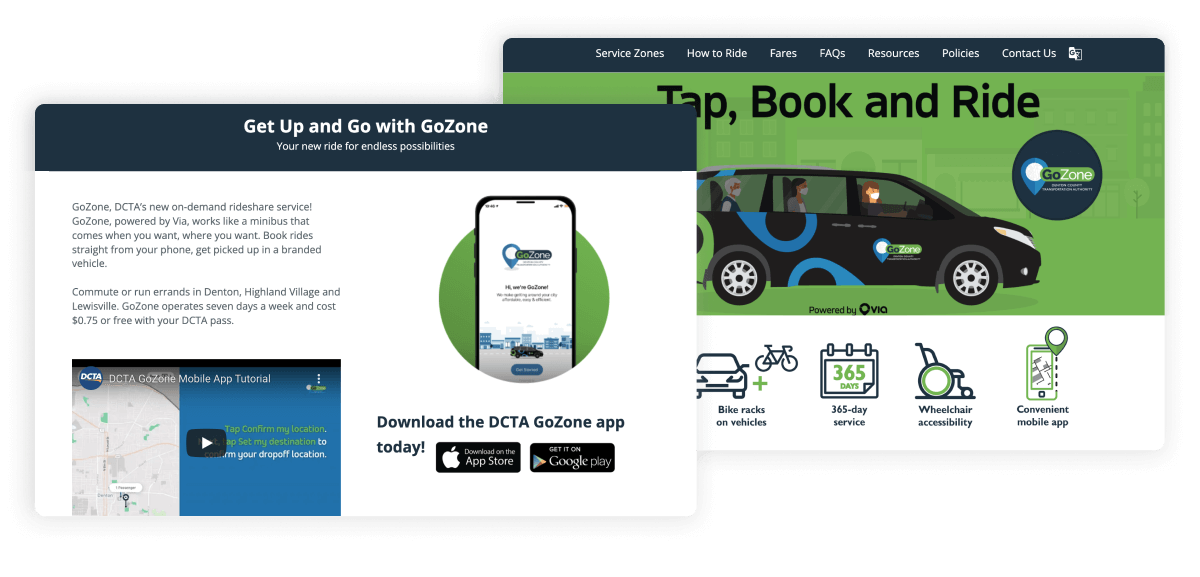
DCTA consistently updated their GoZone site with helpful information and new graphics.
1. Keep your public engagement “hub” up to date.
The GoZone public involvement microsite served as a community engagement hub that provided all key stakeholders up-to-date information and resources. And because we utilized a custom domain for the site, we could be confident in directing all online traffic to this space with zero disruptions to links or URLs. Having one centralized space to host all our project information and feedback gathering tools was incredibly helpful in keeping everyone updated.
Our team made it a priority to proactively update the microsite with new project information and announcements. We wanted to ensure all visitors always had the most relevant information so they could provide valuable feedback. We accomplished this by having a dedicated Media Center and routinely updating our Frequently Asked Questions.
Media Center
A common best practice for any public transit engagement project is to incorporate a dedicated media center. This is important to include in your launch phase as it keeps your stakeholders and community updated on changes to your project, view key project collateral pieces and share current project news with others to increase community engagement participation.
Our GoZone public engagement initiative media center included project announcements, digital collateral, imagery, and logos. During the launch phase, DCTA had numerous project updates that were conveyed to the community such as:
GoZone microtransit project news announcements
Added virtual town halls for public meeting sessions
New informational videos and new collateral for viewing and download
Frequently Asked Questions
Anticipating FAQs your community has about a public engagement initiative will help save your team a lot of additional admin time responding to the same question. Therefore, incorporating a FAQs section at project launch was essential for DCTA.
Even though our team did anticipate certain questions, we quickly noticed via the comments and feedback we were receiving, that there were noticeable gaps in information. We analyzed the feedback, collaborated with various internal departments and updated the FAQs section to ensure site visitors had the information they needed to provide conversant feedback.
2. Use real-time data and analytics to pivot your public engagement strategy.
The nitty gritty work begins after your microsite is launched! Making a dedicated effort to consistently monitor data and metrics is imperative to the success of your public engagement initiative.
Our team analyzed the GoZone microsite daily, carefully reviewing all responses and survey results, which enabled us to develop and present timely project updates. This meant that our board of directors were well informed and could refine their decision-making process for the proposed service.
A key advantage of Social Pinpoint’s analytics dashboard is that you can view all engagement metrics and performance in real-time. This meant we could easily track our public engagement performance against our goals. We also connected our microsite to Google Analytics to allow for advanced analytics measurement. Below is specific data we analyzed during the launch phase to help pivot our strategy:
Social Pinpoint Dashboard
Google Analytics
Total number of visits/unique visits to the site
Top pages visited on the project site
Average time people are on the site
Top paid/organic referral traffic to the site
Unique stakeholders interacting with the site
Bounce rate
Total comments on the site
New and returning users to the site
Number of survey responses
Total page views on the site
Number of project PDF downloads
Average pages viewed per session
Due to the dashboard and system integration offered by Social Pinpoint, we were able to strategically adjust our marketing budget to focus on tactics that were driving the most website traffic and public feedback.
3. Incorporate new engagement tools and promotions to increase feedback.
Public engagement initiatives call for a strategic and nimble approach. So, being able to effectively incorporate new tools and easily tailor upcoming promotions was a great advantage for DCTA.
DCTA could quickly adapt and add new digital engagement tools to increase public feedback with Social Pinpoint. A vital feature DCTA added post-launch was the ability to easily integrate and host virtual public meeting sessions. Like many other transit agencies across the country, DCTA faced challenges with in-person public engagement. This feature was invaluable and enabled DCTA to provide the community with virtual options to hear and view the public involvement presentations in real-time.
To keep engagement consistent, DCTA also implemented a weekly contest promoted via email, social media, and in collaboration with media partners. This promotional push was launched to help collect additional feedback on our engagement tools that were lacking participation.
Each week, we would feature one aspect of the GoZone microsite, whether it was our Ideas Wall, Interactive Map, or a Survey. Each visitor that interacted with the featured tool would be entered to win a prize.
This promotional tactic bolstered DCTA’s public involvement marketing efforts and provided a substantial increase in community feedback and responses. It also helped to ensure that DCTA were receiving a representative and diverse amount of feedback from a larger portion of respondents.
Now that you have the inside scoop from a recent client, reach out Social Pinpoint to schedule your demo and take your public involvement and community engagement project to the next level! Stay tuned for the final series topic that will highlight my reporting experience.
Adrienne Hamilton is an award-winning B2C and B2B marketing and communications professional with more than 10 years of demonstrated success in helping companies build and maintain a positive brand image and exceed business goals. Hamilton served as Denton County Transportation Authority’s (DCTA) Senior Marketing and Communications Manager and spearheaded the agency’s GoZone microtansit public involvement project in which Social Pinpoint was key to it becoming one of the most successful public involvement campaigns in agency history.
In this new three-part blog series, follow Adrienne Hamilton’s journey to get a client-side view of successful project planning, launching, and reporting of a public involvement initiative for transport. Learn how you can also create positive project outcomes with your online community engagement platform of choice. The first installment will focus on effectively planning a public involvement initiative.
As the Denton County Transportation Authority’s (DCTA) recent Senior Marketing and Communications Manager, I was tasked with developing and leading the marketing and communications plan for the agency’s GoZone microtransit public involvement project in the spring of 2021. This new service was slated to launch in fall 2021 – just a few months later. DCTA needed a flexible suite of community engagement tools to carry this off in a short amount of time.
From urban planning and public transportation development to local government projects, the public should always play a vital role in the decision-making process and have their voices heard.
Marketing, communications, and public information professionals across the globe should also work diligently through challenges and obstacles to develop strategic, interactive public engagement initiatives to reach residents, constituents, and stakeholders, so they’re properly informed and can share their feedback on projects that shape their community.
I knew that implementing an online community engagement platform would be necessary to ensure the voices of Denton County would be heard, which is when my team started the search!
Receiving instant help and guidance.
Most of us have heard the saying “the first step is always the hardest.” Thank goodness that proverb wasn’t true when I reached out to Social Pinpoint’s team to learn more about their digital community engagement platform! I was able to schedule a live walk-through of the platform in less than 72 hours and saw “behind the curtain” so to speak.
During my initial call with Social Pinpoint, they not only shared various best practices with me and my team, but we all began to brainstorm solutions for our GoZone public involvement microsite plan. This was of great help since this was our first time developing a digital engagement campaign of this magnitude with so many features.
I instantly noticed a key distinction of Social Pinpoint from other online community and civic engagement platforms: flexibility. We could easily scale up or down based on outreach needs and community engagement goals, which made the process of creating so much easier.
Trialing and testing prior to launch.
I knew our team needed a comprehensive platform to be the foundation for all our public outreach and interactive needs. Being able to trial Social Pinpoint prior to committing to a subscription was so valuable. After receiving access, I quickly discovered that Social Pinpoint is a “one-stop-shop” for all public involvement planning needs.
I was initially worried about how hands-on or technical the platform might be, but those fears dissipated as soon as we received access. The platform was user-friendly and I could easily create an eye-catching and interactive project that met all our needs, specifically for public transportation requirements.
Another important consideration for public transit professionals when planning public involvement is to ensure an inclusive and equitable engagement process that fosters participation by diverse groups of people. This can present unique challenges and had to be kept top-of-mind throughout the planning process. We had to ensure we were effectively engaging hard-to-reach populations including people with limited language proficiency, low-income, and minority communities.
Internal challenges many public transportation agencies seem to face are limited staff, and lack of time and financial resources to fund public involvement software and tools. But, we were determined to overcome these barriers.
So, from a public transit perspective, it was critical that our community engagement platform could support and uplift our team to address these challenges.
Our community engagement platform requirements.
My team knew we had quite a few challenges to overcome when executing our public involvement initiative. Thankfully, Social Pinpoint enabled us to deploy the following public involvement techniques for transportation decision-making:
Accessibility and Title IV Compliance
Numerous creative templates with a responsive design that is Web Content Accessibility Guidelines (WCAG) compliant.
Incorporation of Google Translate so microsite users could change the page(s) to their native language (a vital component for public transit and municipalities when it comes to Title VI of the Civil Rights Act).
Public Transit Software Integration & Location-Based Feedback
Simple program integration upload to showcase transit routes and stops, construction locations, parks and trails, buildings and more (i.e., Remix, Mapbox, Nearmap, Esri ArcGIS).
Location-based feedback on the interactive map feature to analyze comments from “pins” from the microsite visitors.
Stakeholder Management and Topic Sentiment Tagging
List management and topic tagging for simple reporting extraction and download that saves time.
No sign in necessary for the public to comment throughout the platform which increases the percentage of receiving feedback as some people don’t like to give out their personal information.
Ability to measure sentiment for all platform engagements with downloadable charts and graphs for reporting needs (neutral, positive and negative).
Easy exportation of data to help reduce report extraction time and track specific sentiment with various topics for board and public presentation.
Online Community Discussions & Town Halls
Ideation tools, interactive mapping and forum tools to allow for online community discussion where people can comment on various discussion topics and “vote” on them.
Opportunity for our team to respond to all comments and interact with public feedback in real-time.
Virtual town hall feature with integration with Zoom to host online meetings for those who can’t attend in person due to various reasons (i.e., school, work, etc.).
Preparing for project “takeoff”.
After a successful trial period, I quickly purchased the Social Pinpoint package that worked best for DCTA and our public involvement initiative.
As my team was able to kick-start the development of the comprehensive microsite during the trial period, we were able to finalize the build in time for the public involvement launch date. Being able to utilize the draft project we built in the trial streamlined our launch process and allowed us to focus on promotion.
Simultaneously, our team had to develop a comprehensive marketing and communications plan to promote the project throughout Denton County. This would help us to capture a good amount of responses and feedback to help DCTA’s board of directors make the best mobility decisions for the community.
Once again, we were able to tap into the Social Pinpoint team’s vast resource library, helpful guidance and recommendations on how to best promote a public engagement project in your community.
While developing our marketing plan, we made it a priority to include how simple it was to navigate the GoZone microsite in outreach materials, news releases and digital marketing collateral. Key highlights included short “how-to” videos our team created for the Ideas Wall and Interactive Map. They were an absolute hit with our community who appreciated the ease of use for each platform feature.
Stay tuned for the next installment that will highlight my experience launching the public involvement campaign. Reach out to Social Pinpoint and take your public involvement and community engagement project to the next level!
Adrienne Hamilton is an award-winning B2C and B2B marketing and communications professional with more than 10 years of demonstrated success in helping companies build and maintain a positive brand image and exceed business goals. Hamilton served as Denton County Transportation Authority’s (DCTA) Senior Marketing and Communications Manager and spearheaded the agency’s GoZone microtansit public involvement project in which Social Pinpoint was key to it becoming one of the most successful public involvement campaigns in agency history.